


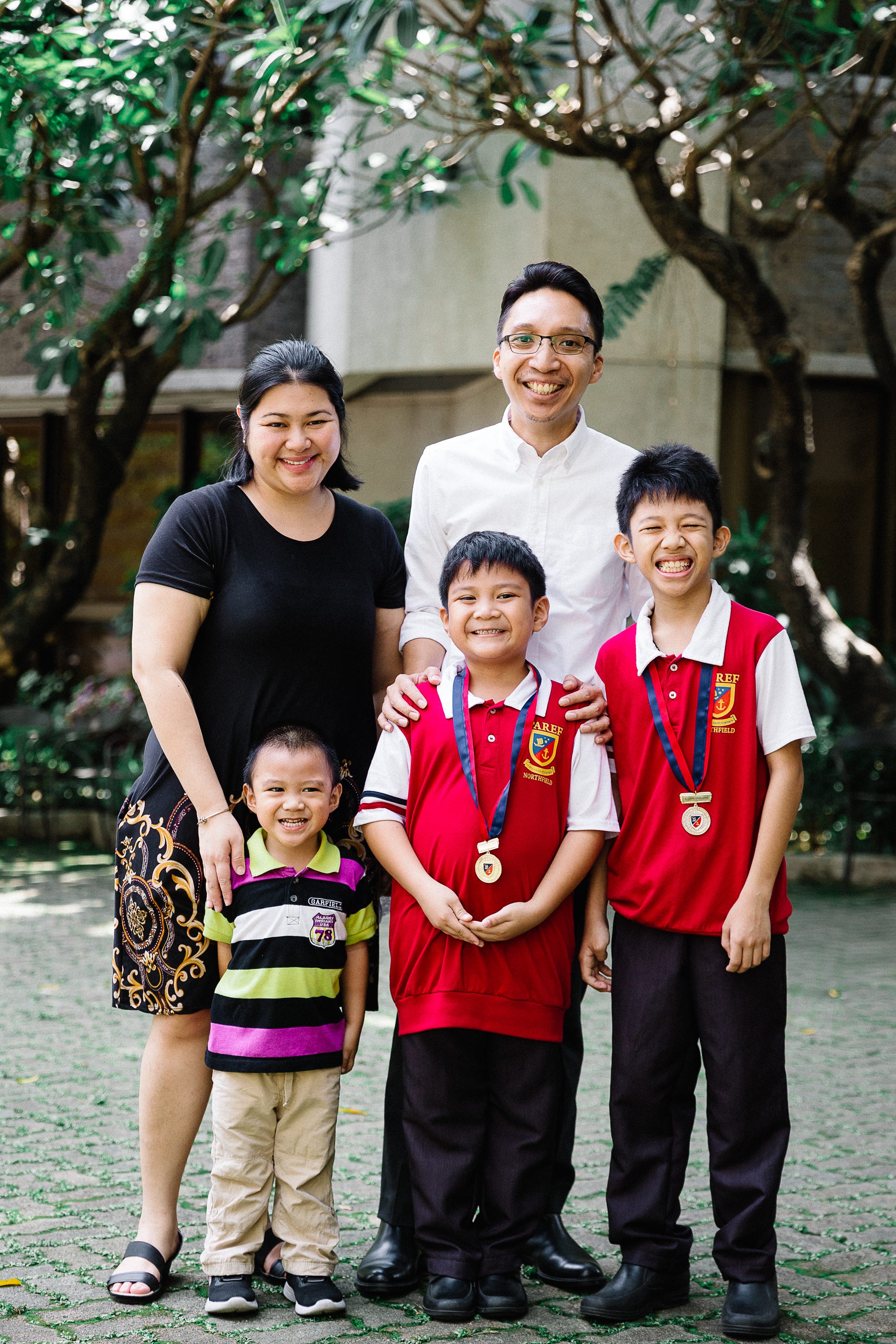
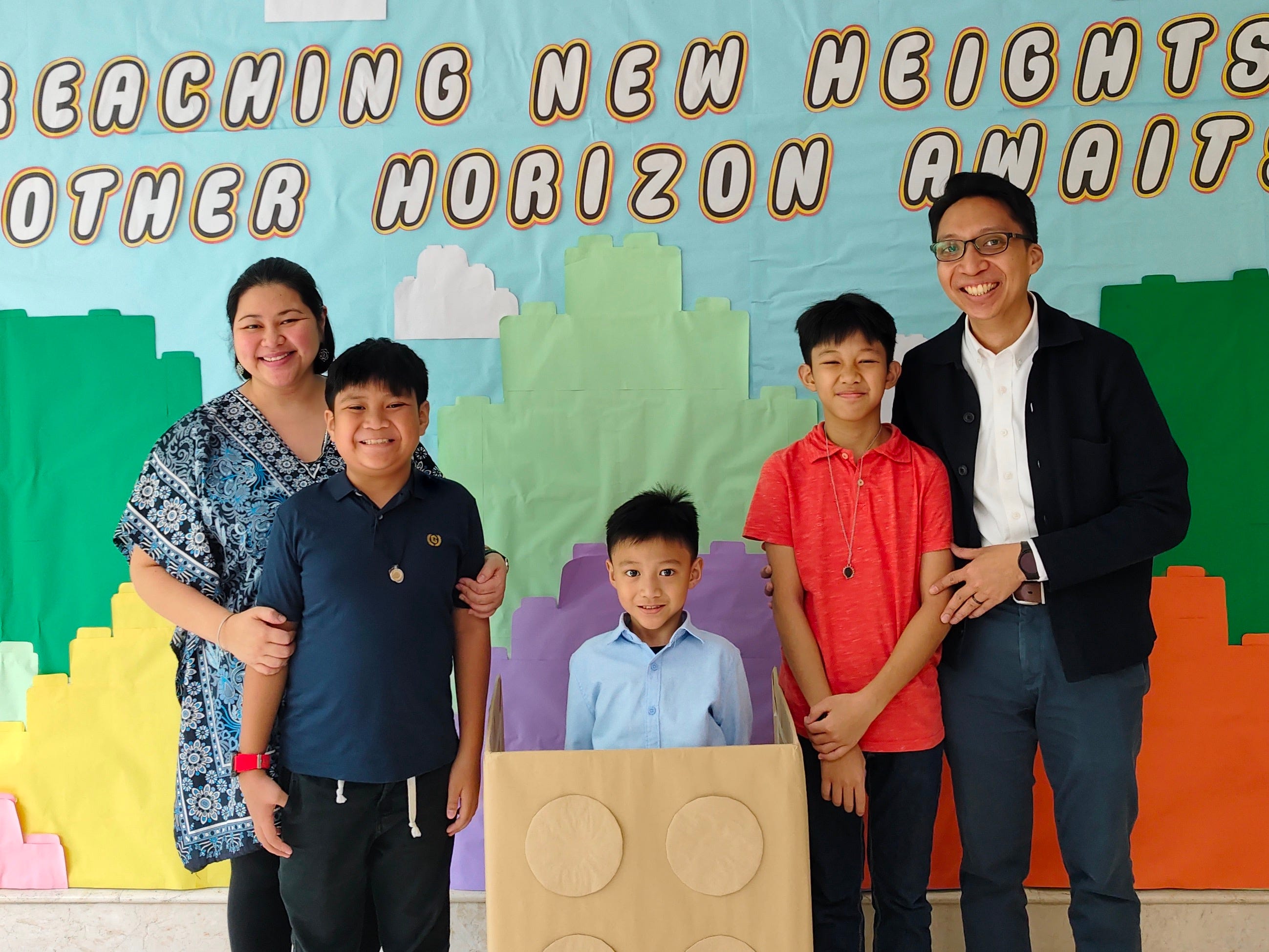
For Father’s Day, I spoke with Dr. Dean Mejos, Vice Dean for Faculty Affairs at the College of Arts and Sciences, who’s raising three boys—Iam, Eli, and Deo—with his wife, Ms. Danes Calantuan-Mejos, a history teacher at UA&P. Over the course of our conversation, he spoke about the work of fatherhood as something learned in the doing rather than planned in advance: guiding without controlling, disciplining without losing the capacity to play, and walking alongside his sons until they can walk the terrain on their own. He returned often to a few convictions—that a father provides in more ways than money, that parents owe their kids an apology when they get it wrong, and that raising a family is teamwork, not competition.
Pio Pantaleon: How would your kids describe you in three words? And how would you describe yourself in three words?
Dr. Dean Mejos: I think they describe me as firstly strict, playful, but also supportive. I think I also see myself the same way. At least it shows that I live by these principles.
Pio: What’s a dad thing you swore you’d never do, but now do constantly?
Dr. Mejos: I never really came into parenting with a particular idea that, “Okay, I’m only going to do this” and “I’m not going to do that.” I came in, and I said, “Okay, whatever’s needed, I’ll get it done.”
But I never said, “I’m not going to do that.” That way, I don’t fall into the typical dad stereotype where dads only do this or dads don’t do that. So, I told myself, “I’ll do what is needed. I’ll do what’s necessary to help.”
Pio: What’s the hardest part of fatherhood that nobody warned you about?
Dr. Mejos: Dealing with the kids. Specifically, supporting, correcting, and guiding them through life. Sometimes you think they’d figure things out, but they just don’t. And then you get frustrated why they can’t figure things out. “It’s so simple!”
But that would be it: walking with them, hand-holding them. But also letting them go.
Kids can do a lot of things, but they don’t know that yet. The father’s role is to show them that they can do it with a little help, and eventually help them realize that they can do it on their own.
Pio: What’s something your children have taught you?
Dr. Mejos: To fool around, to play, to not be too serious. But also, to be serious when it’s needed.
I see some dads that just play with their kids the whole time, and they play the role of a joker. It’s as if they don’t see that disciplining children is part of their responsibility as a parent. All they think about is spending for the kids, playing with them, and think that’s good enough.
With my kids, I realized that it’s fine to laugh and play, but there are times when I have to be serious. It’s important for them to know that, sometimes, they’ll have to do the things they don’t feel like doing.
Pio: What does being a good father mean to you now versus what it meant to you when you first started off as a dad?
Dr. Mejos: One of the things that came to mind is that you have to be a provider. And by that, I don’t necessarily mean provider financially, because you can be a provider in so many different ways. A father needs to be someone who supports their children, encourages them, and helps them discover how far they can go—showing them what they’re capable of.
If a father doesn’t show them their capabilities, then they’re really not going to dare. You have to be there as a guide, but you can’t be there to control. You can’t be there coming in and acting like a dictator. You’re supposed to be there like someone who surveys the terrain, goes back and says, “Okay, this is what it’s like.”
That’s what a father is like or is supposed to be. You’re supposed to be walking with them, but letting them walk the terrain on their own eventually.
Pio: What’s a parenting rule that you’ve stuck to and one that you’ve completely discarded?
Dr. Mejos: I don’t believe in the rule that parents are always right. But I will say that parents usually get things right. So kids ought to listen. But whenever the parents get it wrong, you have to apologize. No questions.
The rule I’ve abandoned is thinking that absolute obedience was a necessary thing. I thought that I just needed to follow my parents. I see that differently now. Sometimes, parents get it wrong. And so, as a kid, you have the right to think for yourself. You have the right to question. But sometimes, you have to obey first and then have a discussion later.
It’s the rule that parents don’t need to explain themselves to their kids. I don’t believe in that. If ever I held on to that in the beginning, I totally abandoned it. Kids deserve to know. Kids deserve to understand. Even if they can’t really comprehend fully yet, but at the very least, the words are in their head, because these things will make sense to them eventually.
Pio: If you could freeze one ordinary moment with your kids, what would that be?
Dr. Mejos: They show their joy and appreciation whenever something good happens to them. If I could freeze that, if I could capture their joy in a crystal and replay it over and over again, that would be priceless. It’s a joy just to see them so happy. Kids are naive, innocent, and therefore not cynical and jaded about life. So when they’re happy, they’re really, really happy.
Pio: How did you grow as a person ever since becoming a father?
Dr. Mejos: I found out that there were so many things that I could do that I didn’t think I could do; many things I should do, which I never really thought I’d be able to do. Fatherhood demands a lot. It’s a thankless job—you don’t do it to get praise from your kids. You do it because these people are counting on you. You do this because it’s good for them, not that it’s good for you. Surely it’s good for you, too—but you don’t really think about that.
Pio: What advice would you give people who are afraid to be fathers?
Dr. Mejos: Don’t think about your fear. Just go ahead and jump into it and face whatever comes. Take good care of your wife, and take good care of your kids.
You can prepare for fatherhood all you want, but you’ll never be ready. So there’s no point in holding back; there’s no point in delaying it.
If you start being a father early, you’ll be “usefully negligent” because you’ll figure things out on your own, as opposed to trying to prepare for any doomsday scenario. The fact is, when you keep thinking, you’re never going to get anything done. So just jump into it and figure it out while you’re there.
Pio: Who do your children love more, mom or dad?
Dr. Mejos: I don’t know. I don’t ask them that question. I just give them as much as I can, the best I can. Parenting is not a competition. It’s collaborative; it’s cooperative because it’s community. That’s why I don’t like the idea of “good cop” and “bad cop.” You have to work together as a team, because if you don’t, you’re going to pull the family in different directions. And you’ll see a very disunited and fragmented family where some members of the family side with one and ignore the other. And therefore, you’ll have a broken family.
Pio: To end on a humorous note: what’s the best dad joke up your sleeve?
Dr. Mejos: We were watching Superman recently.
I said, “Did you know Superman was a thief?”
Confused silence.
“Because he’s the Man of Steal.”