


By Keziah Munsod
1st year Bachelor of Science in Business Administration Student
They never taught us how to prepare for war.
We were taught how to prepare presentation decks, rehearse a thesis defense, and duck under our desks during an earthquake drill. But nobody stood at the forefront of a classroom and taught us what to do when a missile strikes your hometown.
On March 16, 2026, an Iranian missile struck the streets of my hometown, Abu Dhabi, killing a Palestinian expat, not too far from my father’s home.1
Until recent events, Abu Dhabi was simply home. It was the walk with friends from school to the nearest baqala (a local convenience shop) after our last period, complaining about the homework we had yet to start. It was the Lebanese bakery my dad would stop by every morning to get my siblings and me fresh manakeesh (Middle Eastern flatbread with cheese and toppings) before class, where the owner knew our orders by heart. It was the comfort in ordinary routines—the way a home is supposed to be. What’s deemed an ordinary life is fueled almost entirely on an assumed future; you build routines you’d never imagine losing.
My father, an overseas Filipino worker (OFW) of over 14 years, moved my family to Abu Dhabi to give us a better life—an act built on that assumed future. In many ways, it worked. Those very streets shaped who I am, molding my primitive years and embedding the very principles I carry with me today: to respect cultures unlike my own, to adapt alongside upbringings different from mine, and to see customs that once felt foreign as simply someone else’s normal.
Those were the very streets that shaped who I am—the Corniche I strolled along on the weekends, Arabic slang I picked up from classmates, and getting groceries at Al Wahda with my family after church. I thought I knew the roads like the back of my hand, knowing every corner of the very city that raised me. Yet after all those years, I never once questioned where the nearest safety shelter was.
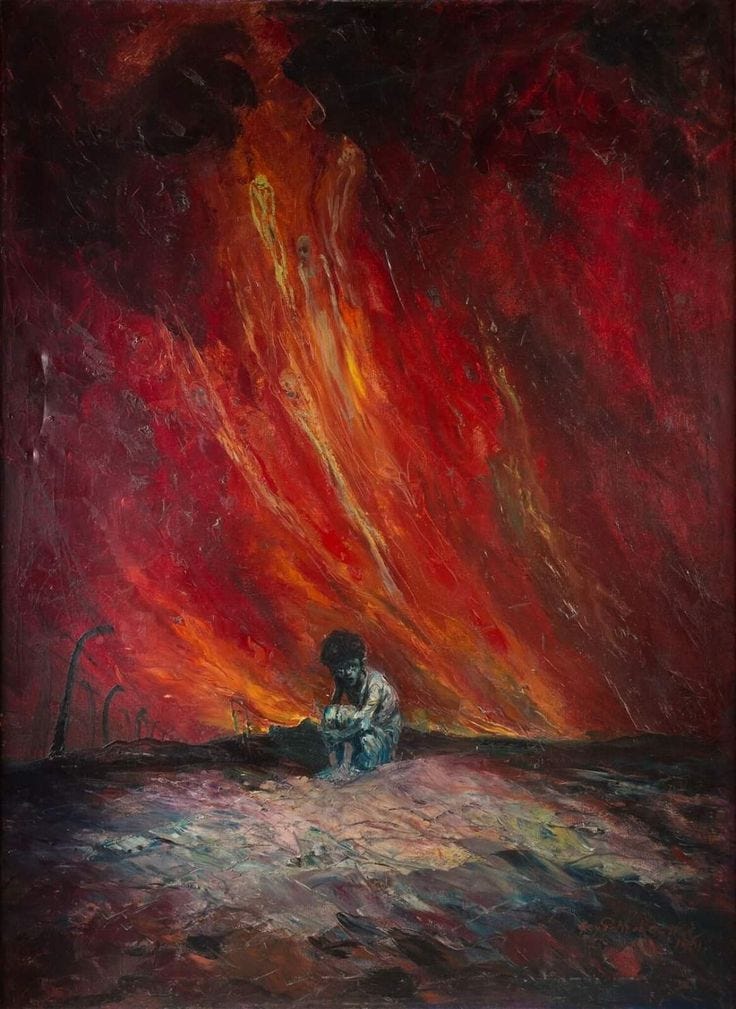
Last June of 2025, Iran targeted the Al Udeid Air Base in Qatar, rattling the Arabian Gulf and shaking the lives of everyone in it.2 I was in Abu Dhabi that summer. Weeks before the strike, I watched my childhood friends walk across the graduation stage in perfectly tailored dresses and suits, holding four years of academic life in a single diploma. After the ceremony, we talked in the venue’s lobby about what college might bring us in the next four years. The future still felt certain.
That was the last time our conversations belonged to the future.
After the strike, our group chat changed. Conversations shifted from the future to the present. A group chat once filled with memes, life updates, and heaps of inside jokes now opens to screenshots of news alerts, stretches of silence, and a friend asking how we’re holding up. Looking back, I don’t think this shift is merely about the news itself—it’s about what stability can give in places its absence cannot. Stability lends peace; it’s what allows one to think ahead: about the future, and for us, about college. Without stability, time turns into a luxury you can’t afford; and everything else collapses into the now.
The reality of everything—the Gulf states closing into open conflict—only started seeping in when the UAE and neighbouring countries closed their airspace, halting my family’s flight back to Manila and almost costing me UA&P’s freshman orientation program. My friends, on the other hand, had to rethink their move-in dates and campus tours. Even our very futures, it turned out, were only ever one closed airspace away from altering the plans we’d looked forward to.
Talking about evacuation plans with your family is something no lecture ever warns you about. And yet it is not uncommon. Families in Sudan, in Ukraine, across Gaza, and the wider Middle East don’t read about this in a headline—they live inside it, a constant present. Their realities are recalculated one day at a time, with almost no room to plan far enough ahead.
In the Philippines, most of us have never had to trade the future in for the present so directly. If anything, most students have grown up with enough stability that their futures were always assumed—a set major, a five-year plan, a life to build without first asking whether there’d be a country left standing in the first place. Not long ago, I was the one who couldn’t take that future for granted. Now I sit in a lecture hall assuming one, while my father is left calculating evacuation routes back home. It’s easy to forget that security is, in part, held up by familial sacrifice—in a parent, a sibling, a Tito or Tita who traded their own nearness for ours so that stability can exist at all. My father sacrificed birthdays, holidays, and simple Sundays, so we could plan our lives without flinching. That is his trade: his present for our future.
And even that trade of life is a privilege of its own compared to what “today” demands of others. For a mother in Gaza, it can mean wondering whether there will be enough clean water to feed her children before nightfall. For families displaced across Sudan and Congo, it’s the next meal, the next safe hour, and a comfortable place to sleep. Some of us worry about missing a flight home; others are only ever worrying about whether there will be a home at all.
War is not a distant concept—not for a country that has so many of its own out and in it. Filipino families don’t often make it into global headlines about war; we’re rarely the ones the world pauses for. But our spirit remains in nearly every crisis zone of the earth because we are the ones who left our homes to make other countries run—to keep hospitals staffed, homes cleaned, oil fields working, children raised. And when those countries catch a flame, it’s Filipino families who quietly tally the math: which flight still flies, which relative can quickly wire money, which embassy will actually pick up the phone.
That’s what the headlines don’t capture.
War is not just close for some of us—Filipinos have learned and grown, generation after generation, how to survive in other people’s wars because not all of us were given the luxury of staying within our own borders for a better life. It’s the sudden phone call in the middle of the night. It’s the group chat that goes eerily quiet, then suddenly floods all at once. It’s a father calculating which route out of the city is fastest—and a daughter, thousands of miles away, waiting to hear if he is alright.
We were never taught to prepare for war, but maybe that’s because no one has figured out how to prepare a person to lose their future tense. Maybe the least we can do is to stop assuming that it only happens to people far away, in some other headline someday, and start recognizing it as our own in the sacrifices of our kababayans.
Staff, Al Jazeera. “Iran Attacks US Airbase in Qatar: What We Know so Far.” Al Jazeera. Accessed September 2, 2026. https://www.aljazeera.com/news/2025/6/23/iran-attacks-us-air-base-in-qatar-what-we-know-so-far.