


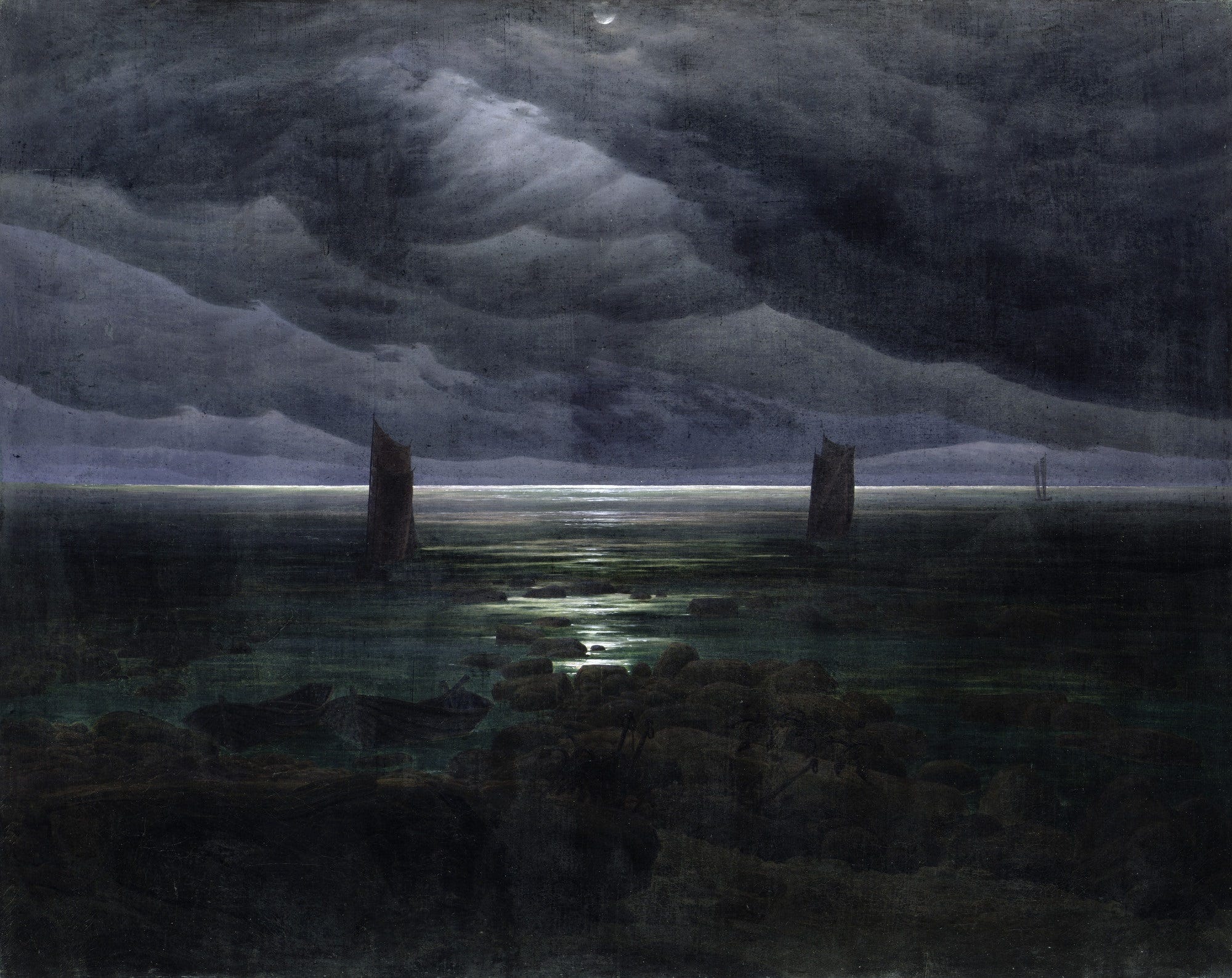
Beyond the eye’s gaze stretches an infinite sea of things apprehensible. Raging in a midnight-blue tempest are the clouds, whose heavy swells on the sky plunge the quiet shore into gloom. Within its undulations—each rolling crest and shadowed valley—are rising leviathans and plummeting abysses that suspend the soul into a degree of horror.
Whether it is in the stillness of the shore or simply in the mental safety of imagining these inky depths, however safe the onlooker actually is from danger, he cannot escape that strange feeling of feeble insignificance. Yet, rather than feel physically endangered, the onlooker encounters a formless terror that reveals a power beyond himself and, consequently, his powerlessness. For as long as we perceive this feeling, we collectively understand that we each play the role of the onlooker.
Even more strange is this negative pleasure—this universal delight—we derive from attempting to perceive a power so formless. The power involved is not just “great”; it is so overpowering that we fail to comprehend it. Given that, the formless is anything that cannot be contained in any sense or form, which in turn produces this aforementioned delight. As paradoxical as the feeling sounds, there exists a thrilling mix of awe and fear. This is what the 18th-century English philosopher Edmund Burke called the sublime.
While not being the first thinker to describe this elusive feeling—that thinker being the Greek rhetorician Longinus1—Burke’s account of the sublime provides the defining properties foundational to an understanding of the term. In short, the sublime is the aesthetic experience derived from encountering phenomena that, due to their immensity and scale, overwhelm the senses.
Consequently, the onlooker of the sublime is left feeling small, vulnerable, and insignificant, since he is rendered in a state of astonishment. By this redefinition, Burke meant the “state of the soul, in which all its motions are suspended to some degree of horror”.2 The mind becomes wholly engrossed by the object—in a cognitive arrest—that it cannot think of anything else. This horror differs greatly from the horrors of an immediate danger. The sublime indeed arises from things vast, immense, but most importantly threatening—things that can cause immediate danger to us; however, the sublime arouses the idea of danger and pain from a safe distance without the onlooker being physically endangered. In short, the idea of danger is divorced from physical harm. The thrilling sensation that arises from confronting the seemingly infinite, raging sea from the position of a quiet shore is one of negative pleasure, or as Burke says, delight. He writes:
When danger or pain press too nearly, they are incapable of giving any delight, and are simply terrible; but at certain distances and with certain modifications, they may be, and they are delightful, as we every day experience.3
Terror had long since accompanied the dimensions of the sublime when Burke first linked it to the dimension of delight. Indeed, no sublime feeling can arise in the vicinity of a destructive storm, nor in the act of being thrown among the waves, since an onlooker’s terror is fixated on self-preservation. Rather, watching the raging sea from the peace of a coast can produce the feeling of the sublime. In other words, the sublime arises only when the terror is abstract enough to occur within the comfort of personal safety. Thus, Burke’s delightful terror emerges when the instinct for self-preservation is nullified by the realization that one is not in actual, immediate danger. Moreover, fear becomes the most effective method to suspend the mind’s motions—its power of reasoning and acting. So universal is this sentiment that it is shared by the Roman poets who said:
Primos in orbe deos fecit timor.
Or, “Fear first made gods in the world.” If fear reveals an imagined danger, the fear in the sublime reveals a human fragility. However, as foundational as Burke’s account is, it stumbles across three critical flaws. Firstly, he limits the feeling of the sublime to the aforementioned dimension of delight. By limiting it to mere fear and pain, he limits the experience to only an expression of self-preservation. Secondly—as a result—he fails to give an efficient explanation for excluding the dimension of positive effects in the sublime, such as moral grandeur and awe-inspiring acts of human courage. Thirdly, he limits the perception of the sublime to sensory information. When Burke limits the sublime to sensory impulses, he also limits the person to a sensory will, thereby ignoring his rational nature. Neither is this an adequate explanation to account for an experience so abstract as the sublime, for Burke’s fiercely empirical conception of it suspends the onlooker into a state of horror and leaves him stranded on a placid island of insignificance.4 Thus, the onlooker stands hopelessly. Nevertheless, he partially succeeds in rendering a proper account of the sublime by making the foundational claim that whenever power is only useful to utilitarian benefit and pleasure, its strength does not produce the sublime.
The horse in the light of a useful beast, fit for the plough, the road, the draft, in every social useful light the horse has nothing of the sublime; but is it thus that we are affected with him:
whose neck is cloathed with thunder, the glory of whose nostrils is terrible, who swalloweth the ground with fierceness and rage, neither believeth that it is the sound of the trumpet?
In this description, the useful character of the horse entirely disappears, and the terrible and sublime blaze out together. We have continually about us animals of a strength that is considerable, but not pernicious.5
The sublime ought to be magnificent; the power of the sublime arises when we see the power as an end in itself, not as a means to certain ends. Immanuel Kant reflected on this and sought to express the abstract complexity of the sublime. For the German philosopher, finding pleasure in the fear and pain associated with a raging storm would mean going against the immediate interest of the senses.6 Therefore, he argues against Burke: the sublime is not simply an expression of self-preservation, but it is an experience of human elevation.
In his Critique of Judgement, Kant points out that it is not the phenomena themselves that constitute the sublime, but rather the discovery of a human transcendence—an ability to rationally surpass the phenomena—that constitutes it as an elevation. What one discovers is a person who is beyond sensory impulses. The feeling of terror when watching a storm is elevated to the sublime when the onlooker realizes his rationality over brute nature. While a violent storm can break and batter his body, it cannot break his resolve; for his is a resolve of rationality to derive a purpose from the world. It is because of this that if one is capable, through reason, to attempt to grasp the very concept of infinity, it indicates the mind’s power to “surpass every standard of sense.”7 For the onlooker,
Sublimity is contained not in any thing of nature, but only in our mind, insofar as we can become conscious of our superiority to nature within us, and thereby also to nature outside us. Whatever arouses this feeling in us, and this includes the might of nature that challenges our forces, is then (although improperly) called sublime. And it is only by presupposing this idea within us, and by referring to it, that we can arrive at the idea of the sublimity […] by the ability, with which we have been endowed, to judge nature without fear and to think of our vocation as being sublimely above nature.8
If Burke’s account is foundational, then Kant’s is revolutionary. The former suspends the soul in a degree of horror, and leaves it wafting on the fringes of uncertainty; the latter transcends the soul unto an elegant certainty. One stops at astonishment, whereas the other moves towards edification. The project of the sublime then shifts focus: one becomes concerned with enriching one’s moral and intellectual life, for what truly becomes sublime is the person. In short, Kant provides us with a potent redefinition: the sublime is that aesthetic experience derived from encountering phenomena that, due to their immensity and scale, awaken the person to a higher state of living.
To suppose that Kant represses the fear and insignificance present in the sublime is to misunderstand him entirely. It is quite the contrary; he sees them as essential to the process. He champions the dimensions within negative pleasure as a starting point for edification. Kant’s onlooker of the sublime understands this relationship, for fear is not a letter of rejection; fear is an invitation to ascend.
Yet the sight of them [sublime objects] becomes all the more attractive the more fearful it is, provided we are in a safe place. And we like to call these objects sublime because they raise the soul’s fortitude above its usual middle range and allow us to discover in ourselves an ability to resist, […] which gives us the courage [to believe] that we could be a match for nature’s seeming omnipotence.9
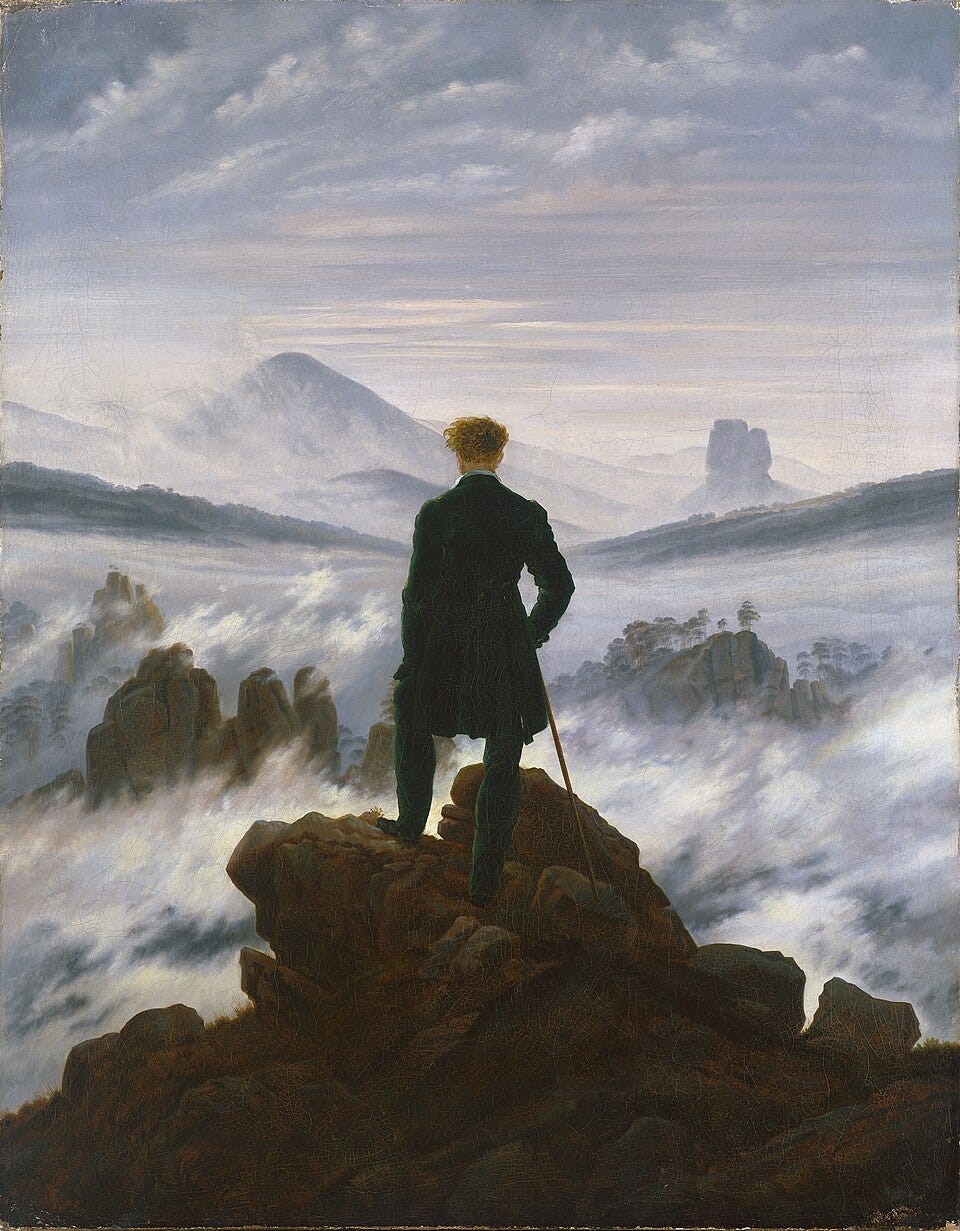
An instinctual fear of the sublime is necessary for it to manifest, insofar as confronting it is necessary too. Concretely speaking, that would look like the depths of an ocean spanning beyond the horizon, which instills a formlessness. It is not just “big”; it is so massive that the mind fails to hold its scale. Conversely, the form would mean something we can contain in our minds, and that the form would be our capacity for comprehension. In confronting the fearful and formless ocean that is beyond sensory understanding, we affirm living itself. As onlookers, we do not simply recognize our physical fragility, as Burke supposes, but triumphantly understand as well where we stand in the world: the formless elevates the form.
And yet this same violence that the imagination inflicts on the subject is still judged purposive for the whole vocation of the mind.10
The human person, in definite form, evolves by the times; but that which is sublimely formless never will, for ultimately, the sublime is an encounter between self-transcending humanity and the self-contained world around it. As long as we retain a consciousness that we are capable of going beyond formless things, as Kant did, then the feelings that persist in that unceasing confrontation remain.
What only evolved was our understanding of the sublime and how an aesthetic experience can awaken us to a higher state of living. Edmund Burke and Immanuel Kant may have defined and redefined the term in the 18th-century, but they stumbled upon an irrefutable sea of triumph already existing. It only becomes evident that as 21st-century onlookers, we ought to rediscover that irrefutable sea and redefine the term that mankind has found to be properly called the sublime.
This feature is part of a two-fold series by the author. Stay tuned for part two.
References
Burke, Edmund. A Philosophical Enquiry into the Origin of Our Ideas of the Sublime and Beautiful. Edited by David Womersley. 1757. Reprint, London: Penguin Books, 2004.
Kant, Immanuel. Critique of Judgment. Translated by Werner S. Pluhar. 1790. Reprint, Indianapolis: Hackett, 1987.
In his 1st-century treatise On the Sublime, Longinus defined the sublime as a lofty, elevated style of rhetoric and language capable of arousing audiences with an overwhelming emotion.
Burke, Philosophical Enquiry, 101.
Ibid, 86.
The wording I have used here is loose callback to the famous opening line of H.P. Lovecraft’s The Call of Cthulhu: “We live on a placid island of ignorance in the midst of black seas of infinity, and it was not meant that we should voyage far.”
Burke, Philosophical Enquiry, 108-109.
Kant, Critique of Judgment, 127. He writes: “[the] sublime is what, by its resistance to the interest of the senses, we like directly.”
Ibid. 111
Ibid, 123.
Ibid, 120.
Ibid, 116.
