


By Dr Nick Alviar
Faculty member, School of Politics and Governance
Amid growing Chinese assertiveness in the South China Sea, the recent visit of US Secretary of War Pete Hegseth to Cebu for the ASEAN Defense Ministers’ Meeting-Plus signals strong American support for regional allies. This is particularly significant for its Mutual Defense Treaty partner, the Philippines, which faces direct confrontation over Beijing’s “ten-dash line” claims in its Exclusive Economic Zone (EEZ)—particularly around the Spratly Islands and Scarborough Shoal—in violation of the 2016 Arbitral Ruling at The Hague.
The visit underscores the Trump administration’s commitment to regional stability and to deterring Beijing’s threats and reliance on force. This stance comes in the wake of recent remarks by China’s ambassador to the Philippines, Jing Quan, who stirred controversy by claiming Beijing could “easily win” a military conflict with the Philippines if force is used. According to a Pentagon statement, Secretary Hegseth’s objective at the ASEAN meetings is “to reaffirm America’s commitment to peace through strength in the Pacific” while pushing to “strengthen deterrence, advance key alliances and partnerships, and expand burden-sharing across the region.”
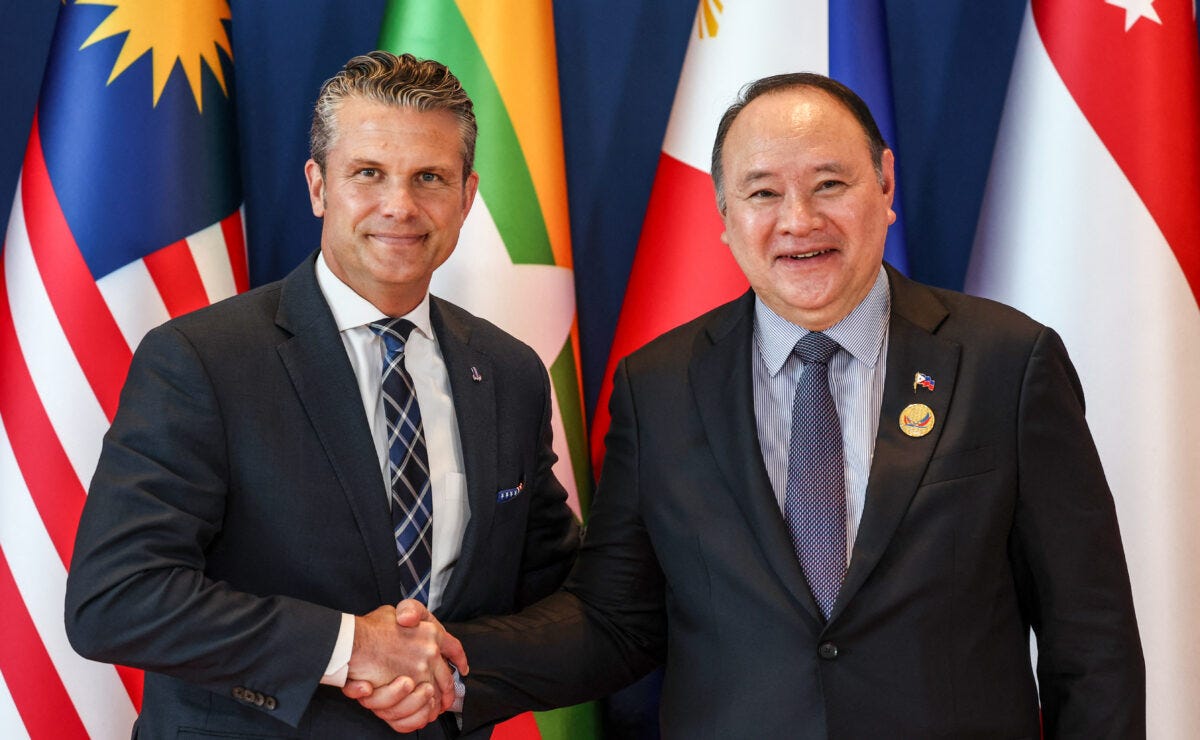
During an Oct. 28, 2026 meeting, Secretary Hegseth and Department of National Defense (DND) Secretary Gilberto Teodoro Jr. discussed alliance modernization and security cooperation. The two leaders agreed to initiate an alliance command-and-control modernization sprint to strengthen real-time bilateral coordination and resilience. They also committed to operationalizing bilateral Enhanced Defense Cooperation Agreement (EDCA) sites through infrastructure and storage investments across the Philippines.
Furthermore, Secretary Hegseth announced increased security cooperation funding from the US Department of War to accelerate Armed Forces of the Philippines (AFP) modernization and enhance interoperability along the First Island Chain.
To maximize the impact of these additional support, and to counter growing external threats, funding should be prioritized in three key areas:
Maritime Defense: Given the Philippines’ archipelagic geography and vast maritime domain, resources should be allocated to expand the capabilities of the Philippine Coast Guard and Philippine Navy. This is critical to monitoring and countering the presence of foreign forces in disputed waters.
Cybersecurity: Increased assistance is needed to fortify government security and communication networks against aggressive enemy cyber infiltration.
Unmanned Aerial Systems and Defensive Drone Warfare: Developing defensive drone technology offers a cost-effective alternative to large-scale military hardware.
US assistance in drone tech development would significantly bolster asymmetric defense capabilities.
Given the growing security challenges, our current military capabilities remain inadequate. Thus, for practical and strategic reasons, cultivating a long-term partnership with the United States is essential—anchored by our shared history and longstanding Mutual
Defense Treaty. Expanding joint maritime patrols with the US in the West Philippine Sea is a critical step in this direction.
Simultaneously, we should broaden our defense and security cooperation with other key regional and international partners, including Japan, South Korea, Australia, New Zealand, France, India, Canada, and ASEAN member states.
After that visit, the US Ambassador Lee Lipton issued a statement addressed to the people of the Philippines:
“Our commitment to Philippine security is ironclad. With President Ferdinand Marcos, Jr., the United States and the Philippines have built a powerful partnership grounded in shared principles, mutual respect, and an unwavering commitment to regional stability … We’re in this for the long-term … We stand firmly with the Filipino people in defending sovereignty, protecting territorial integrity, and upholding the freedom of navigation on which we all rely for vibrant global commerce … The United States is proud to call the Philippines an ally, partner, and friend. Our relationship is not simply a matter of treaties or shared strategic interests; it is a bond between our peoples that grows stronger every day.”
In today’s increasingly anarchic world where “might is right,” building alliances — for the Philippines — is right.
The views expressed here are the author’s and do not necessarily reflect those of the Publication and the University.