


Christopher Nolan’s The Odyssey was, without a doubt, a spectacular movie. The first weekend here in SM megamall was already sold out of IMAX tickets. I had a mini-Odyssey with my dad going to Pampanga just to watch Homer’s Epic on the biggest screen. Even last year, there were many pre-order tickets sold out across the world. I admire Nolan’s dedication to film the entire movie with a gigantic 70 mm camera across the great expanse of the Mediterranean ocean. The whole project was dedicated to his longtime friend and mentor David Keighley who oversaw and promoted IMAX in Hollywood for more than 40 years until his recent passing last year.
Despite Nolan’s intention for the movie, the months leading up to the theatrical release brought controversy regarding choice of casting and accuracy of the script with Homer’s text. When I sat down to watch the Odyssey with my colleagues for the first time, I heard a meandering laugh to my right when the first person we saw on screen was Travis Scott, dropping some beats on a replica of a 12th century BC dining table. As a literature teacher, I already knew this was a different take from one of Homer’s greatest epics. However, I wanted to know how far Nolan reframed Homer’s ancient hero. So I’m endeavoring on this review and analysis of Nolan’s adaptation to one of Homer’s beloved stories. Spoilers ahead.
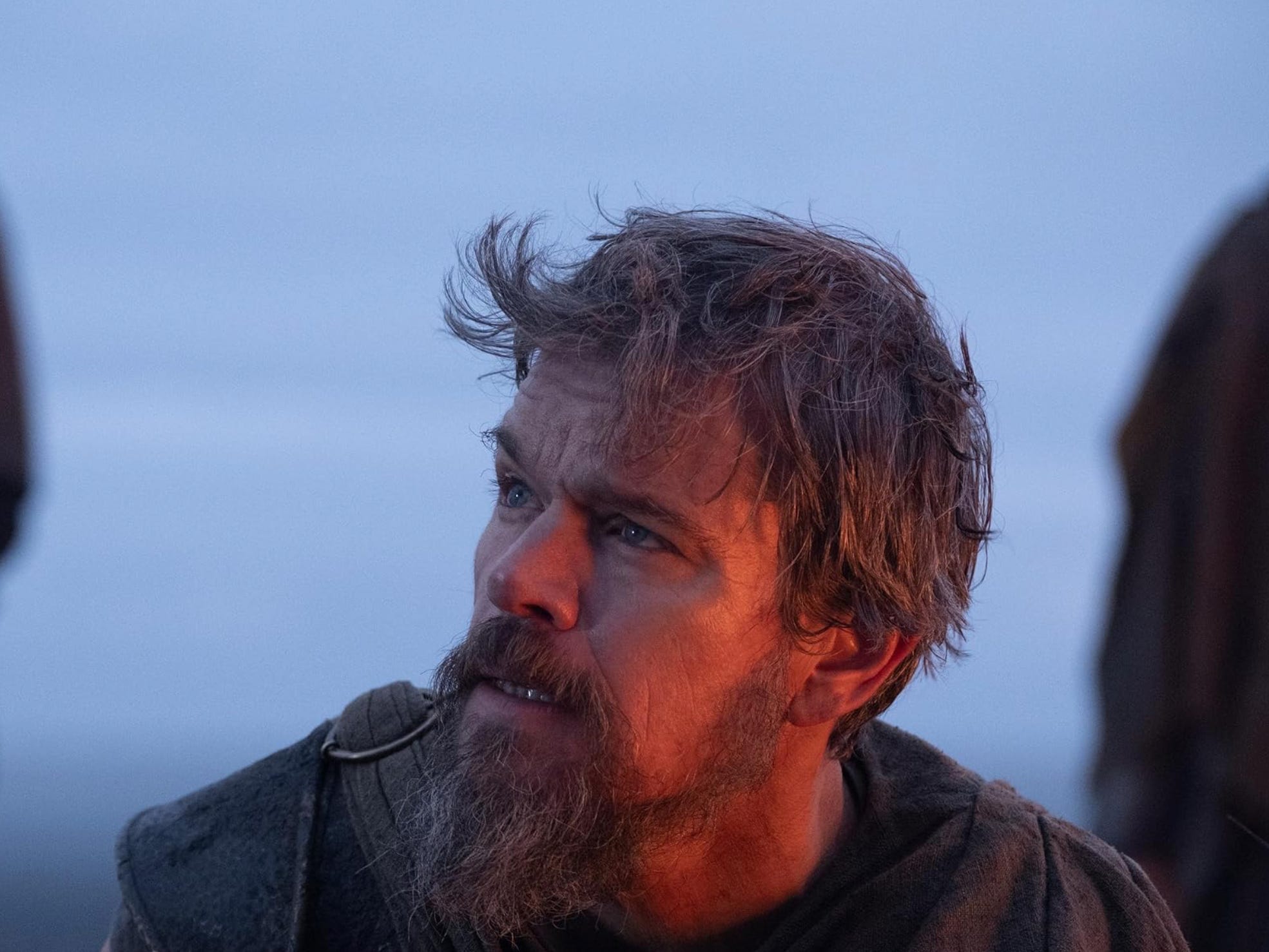
One of the biggest achievements of this movie was trying to bring Matt Damon home. Dr. Joem Antonio pointed out to me that Nolan unknowingly (or perhaps intentionally) brought out “the Matt Damoniest movie of Matt Damon movies,”1 which made the 3-hour movie felt a bit shorter than expected. Matt Damon was a war survivor (Saving Private Ryan), a clever tactician (Good Will Hunting), a navigator stranded in a faraway land (Interstellar), an undercover operative (The Departed) and most importantly, an amnesiac assassin (Jason Bourne Series). With all these movies, Matt Damon has practically become his own genre. He may not be casted as a major superhero (except for that one moment in Thor: Ragnarok) but he finally found his own superhero as one of Homer’s most famously written generals, Odysseus.
The Odysseus I encountered in Nolan’s The Odyssey actually feels less like Homer’s hero alone and more like a homage to Dante Alighieri’s version. Inferno 26 depicts a tragic version of Odysseus who crossed the strait of Gibraltar, only to find his whole ship obliterated, his men taken by the sea, and Odysseus himself damned in the fires of the Fraudulent Counselors. What appears to be a Titanic incident is, in fact, the work of a leader who weaponized his intelligence against his own men, hiding the weight of divine prohibition in the guise of bravery. “You were not made to live your lives as brutes, but to be followers of worth and knowledge.”2 Such a statement speaks true of our own potential. Imagine how this spurred Odysseus’s men to venture forth where no man has gone before. Yet the problem already lies in the act alone, going where no man has gone before, where Odysseus removed the deadly implication, they might all just die.
Nolan imitates this same tragic fate with some of Odysseus’s actions, especially using Sinon as bait in luring his enemies to accept the Trojan horse as a peace offering and dedication to Athena. When they met in Hades, Odysseus kept calling Sinon brave despite Sinon feeling the weight of his wasted life, knowing the consequence of being used by Odysseus. His men even became defiant of him when he chose to strike an arrow to the Cyclops out of spite. The central theme focused so much on the unburied dead that he left as casualties. Odysseus showed no explicit moments of remorse, but he moved on with his intelligence leading them to more unchartered territories. Nolan’s Odysseus is not merely cunning; he is a man whose intelligence helped him against many obstacles but sadly destroyed him.
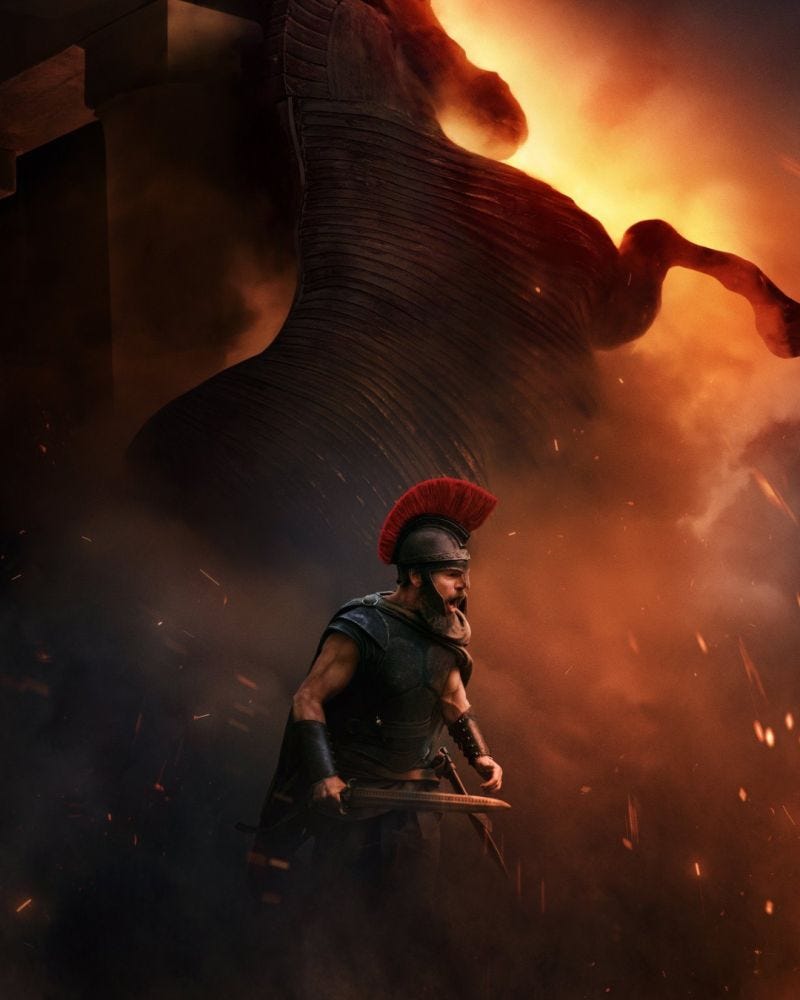
At first, his intelligence resembles cunning or what we Filipinos call diskarte—outmaneuvering someone by wit and observation. Odysseus always planned two steps ahead and earned his reputation as the smartest and most cunning of the Greeks. Yet Nolan refuses to celebrate cunning for its own sake. Odysseus’s plan to construct the Trojan Horse was more than a military strategy—the Trojan Horse was a betrayal of Zeus’s law that turned a whole city upside down. That law is the bedrock of civilization, and the Trojan horse cast it aside into a bloodbath driven by rage, vengeance, and sacrilege.
Witnessing Troy burn down to the ground felt devastating. People were running aimlessly from the streets, Trojan warriors were almost lined up in a chopping block, and Greek warriors pillaged without mercy left and right. The character of Zendaya was apt to be Athena because she was also among the innocents that Odysseus saw beheaded. The camera never fully shot her beheading but instead cut to the statue of Athena desecrated as remnant of a ransacked Troy. This showed the sacrilege that Odysseus helped bring about because of the Trojan horse. Despite a wildfire that lit up the whole city, Troy was enveloped by the darkness of the Greeks, their long-held rage for 10 years finally came to a close, or so they thought.
The film kept repeating how abandoning Zeus’s law affects everyone. It simply follows what we know about natural law today. The only difference being that it focuses on treating guests with hospitality because they might be gods in disguise. Disobeying this law seems cruel but Nolan’s movie takes this even further. Disobedience invites destruction to unfold in a domino effect: it infects the person, pollutes interpersonal relationships, and ultimately destroys civilization itself. Odysseus felt this deeply. That is why when he talked to Penelope as a beggar, he was expressing the long-held trauma within. The massacre in Troy was never a well-earned victory by the Greeks. The first act of the film shows Odysseus’s own mind suppressing his memory of Troy. Perhaps that is why the sequence of events in Troy were never fully shown but only in sparse moments. Odysseus focused more on getting himself and his men back home. It was worse for his men because they normalized the atrocity they had committed. In a town not so far from Troy, they pillaged the villagers for food. So, a whole whirlwind of punishments awaited them from the gods as Odysseus’s men set sail back to Ithaca. Even Athena appeared before Odysseus with disdain.
These punishments from the Gods appeared as great forces of nature and mythological creatures that brought death to each and every one of Odysseus’s men. Burke’s idea of the sublime perfectly captures the vastness and terror that was inflicted towards them.3 The sheer scale and deafening roar of the Cyclops, Scylla, and Poseidon’s relentless, crashing waves reduced the Greeks to nothing but extinguishable pawns in their world. Most notably, the Laestrygonians, men who were almost twice the size of Odysseus, massacred almost all of Odysseus’s men and destroyed his two escort ships, leaving him to escape with only one ride home. To think that all those scenes were done in the Mediterranean itself with real props and real danger, made it more impressively horrifying to experience in a movie theater.
Odysseus was portrayed as a rebel against the gods. He remained defiant of their power, unleashing his own vengeance upon the Cyclops and never giving a proper burial for his men. When Odysseus’s men were all devoured by the waters of Poseidon, he arrived on Calypso’s island like a patient waiting to be examined.
Odysseus is an interesting patient. Besides Dante’s version, Odysseus resembled so much of Shakespeare’s Hamlet as well. The way Hamlet procrastinated to fulfill his father’s request resembles Odysseus’s 8 year long stay in Calypso’s island, eating Lotus flowers and living a simple life with Calypso. Hamlet and Odysseus were given another chance in finishing what they started. Penelope’s brooch, a tiny figure of Athena, became his lifeline. When Calypso finally saw that Odysseus no longer relied on Lotus flowers, she gave him back what he needed. Gripping the delicate gift amidst the horrifying chaos, we see a man who finally recognizes his own fragility. It isn’t his intellect or cunning that brings him home, but his desperate hold on this small, beautiful reminder of his wife, a reminder of whose unnamed innocent woman was beheaded because of him, and a reminder that it isn’t too late to go back home after all those lost years. The brooch fits well with Burke’s definition of the beautiful: that which is small, light, and fragile.4
That is why Odysseus’s return home was providential. Both Hamlet and Odysseus submitted to fate, no longer meandering, and no longer defying God. They became true to themselves and accepted what life throws at them at that moment. “We defy augury. There is a special providence in the fall of a sparrow.”5 Odysseus arrived in Ithaca posing as a beggar, succeeded in the contest proving that he is worthy for Penelope, and exterminated all the suitors. The last part seems like it came out of an action movie that solved everyone’s problems, but that’s not the case.
Odysseus fulfilled his wife’s request and since Antinous did not accept the lot, Odysseus was forced to deal with the suitors in honor of Sinon’s request from the afterlife. Odysseus honors the dead, and the bloodshed that Odysseus committed still comes at a cost. Compared to the original ending from Homer where Athena directly intervened and made a treaty, Nolan’s version carries more reverence for the afterlife. Odysseus heads west with his wife to bury the dead and honor his fallen comrades. It may seem like an ordinary visit to the morgue. However, this was Odysseus’s reclamation for the sacred. He is paying for the price for his own defilement of Zeus’s law and perhaps that is why the Gods let Odysseus cleanse Ithaca of its own wannabe usurpers.
In the end, he returns to fulfill what his wife wanted: “to chase the escaping sun”.6 It seemed like a fairy tale ending between two lovers, but this was a poetic conclusion of Penelope and Odysseus embarking their own odyssey together. The war on Troy was never isolated. Ithaca itself faced the consequences of Odysseus’s actions, and his last act was to reclaim what is sacred.
Behind the jarring Travis Scott cameo lies a profoundly human story, one that exposes effects of betraying Zeus’s law. Nolan’s Odysseus embodies both Dante’s version and Shakespeare’s Hamlet. Nolan treated Homer’s character not as a as a rigid, untouchable relic. Nolan’s Odysseus captures the cunning he was known for, while adding another layer that pays deep reverence to the afterlife and death. The film reminds us that we are all lost at sea at some point, battling forces much larger than ourselves. But as long as we hold onto the small, beautiful things—the lifeline of our humanity—there is always a providence which comes at the right time to lead us home.
Joachim Antonio, interview by author, June 21, 2026.
Dante Alighieri, Inferno, trans. Allen Mandelbaum (New York: Bantam Books, 1982), 26.119–120.
Edmund Burke, A Philosophical Enquiry into the Origin of Our Ideas of the Sublime and Beautiful (1759), 114.
Edmund Burke, A Philosophical Enquiry into the Origin of Our Ideas of the Sublime and Beautiful (1759), 119.
William Shakespeare, Hamlet, ed. Barbara A. Mowat and Paul Werstine (New York: Folger Shakespeare Library, 2012), 5.2.233–234.
The Odyssey, directed by Christopher Nolan (Universal Pictures, 2026).
