


By Atty. Jemy Gatdula
Dean, UA&P Law School
“Thank heaven for a man who makes up his mind,” M tells James Bond in Moonraker. But clearly nations, no less than individuals, must utterly know what they are trying to achieve. The Philippines — well, at least hopefully — is doing finally that.
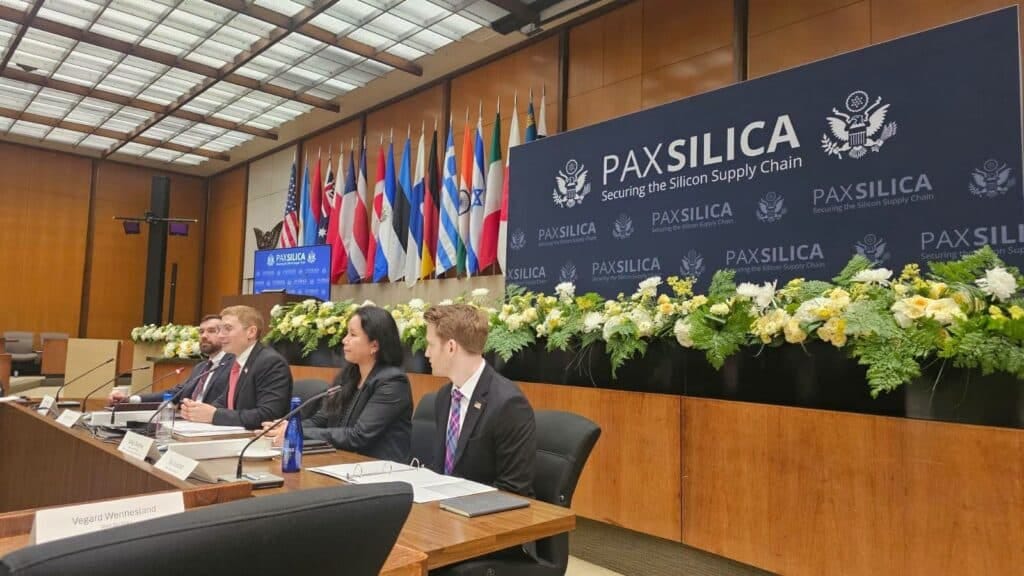
Mere consideration of the US-led technological initiative known as Pax Silica is an appropriate response to China’s repeated weaponization of trade, investment, tourism, and supply chains against States resisting its geopolitical ambitions. The Philippines, along with Australia, Japan, South Korea, and — of course Taiwan — have experienced varying forms of economic coercion. Reducing dependence on China is no longer merely an economic policy. It is a national security imperative.
For decades, the Philippines remained trapped in low-value manufacturing while our neighbors advanced into semiconductors, artificial intelligence, advanced electronics, and other high-value industries. Pax Silica offers perhaps the country’s best opportunity in a generation to reverse that pattern.
Government projections estimate that the initiative could attract US$40 billion to US$70 billion in investments into semiconductor manufacturing, artificial intelligence, cloud infrastructure, critical minerals processing, and advanced logistics. The New Clark City component alone is projected to generate more than 130,000 high-quality jobs, while the broader Luzon Economic Corridor could eventually support as many as one million jobs across manufacturing, logistics, research, construction, and supporting industries. More than 50 multinational companies reportedly expressed interest in participating. There are suggestions that successful implementation could propel the Philippines toward double-digit economic growth.
More importantly, economic modernization and national security, for once, point in the same direction.
Yet strategic necessity does not justify constitutional shortcuts. Reports that early negotiations contemplated Economic Security Zones with diplomatic-style immunities or the application of foreign legal standards deserve scrutiny. Whether floated rumor or merely proposed is almost beside the point. The issue is constitutional principle.
Article I declares Philippine territory and with it, Philippine sovereignty. Article II.7 commits the State to an independent foreign policy in which the paramount consideration is national sovereignty, territorial integrity, national interest, and the right to self-determination. Article II.19 directs the State to develop a self-reliant and independent national economy effectively controlled by Filipinos. None of these provisions prohibits strategic alliances but all of them prohibit surrendering sovereign authority.
The Supreme Court in Nicolas v. Romulo recognized the Executive’s authority to conclude international agreements while emphasizing that constitutional limits remain controlling. Foreign corporations, technical advisers, and strategic partners operating within Philippine territory remain must subject to Philippine jurisdiction. No Economic Security Zone should become a legal enclave where Philippine labor laws, environmental regulations, tax rules, or criminal statutes cease to apply.
The same constitutional discipline governs strategic natural resources. Article XII.2 embodies the Regalian Doctrine, reserving ownership and ultimate control of natural resources to the State. Section 10 likewise authorizes Congress, when the national interest so requires, to reserve certain areas of investment to Filipino citizens or corporations predominantly owned by them. In La Bugal-B’laan Tribal Association v. Ramos, the Supreme Court sustained foreign participation in mining only because the Philippine government retained ultimate control, supervision, and management. Foreign corporations cannot determine Philippine resource policy or direct extraction solely to satisfy foreign strategic priorities.
Pax Silica should also be seen within the greater framework of Philippine international trade commitments. The Philippines is a founding member of the Regional Comprehensive Economic Partnership (RCEP), the world’s largest free trade agreement, as well as participant in ASEAN economic integration. And yes, international economic law has long recognized that States may adopt measures necessary to protect essential security interests.
But while sensitive technologies, semiconductor supply chains, cyber infrastructure, and critical minerals occupy fundamentally different legal and strategic categories, requiring resilience, diversification, and cooperation with trusted allies, traditional commerce in agriculture, consumer goods, tourism, and conventional manufacturing should continue to benefit from RCEP’s liberalizing framework. The challenge for policymakers is to balance the aims of trade with economic and military security.
Indeed, there are “mutual benefits of international trade and investment, enhanced and enabled by bold public investment in key sectors; bounded in rare but essential cases by principled controls on key national security technologies; protected against harmful non-market practices, labor and environment abuses, and economic coercion; and critically coordinated with a broad range of partners.” So says then US National Security Advisor Jake Sullivan (remarks at the Brookings Institution in 2024).
Hence while it is obvious that the Philippines should enthusiastically embrace Pax Silica, it should do so as a sovereign constitutional republic.
Philippine courts must retain jurisdiction. The State must preserve genuine control over strategic natural resources. Because clearly the West Philippine Sea cannot be defended by military strength alone. A comprehensive archipelagic security has to include industrial strength, economic independence, and national self-respect.
Pax Silica offers the Philippines that opportunity, but it should never just be an American project in the Philippines but rather a respectful partnership by the US and other allied countries with the Philippines. In that crucial distinction lies the key.
This piece was originally published in Atty. Gatdula’s column, “Being Right,” in BusinessWorld on 14 August 2026. The views expressed here are the author’s and do not necessarily reflect those of the Publication and the University.