


The first tennis match I ever watched was Alex Eala’s match against Iga Świątek—world no. 3 and Wimbledon’s defending champion. I learned the rules in real time, the people around me explaining the sport between rallies, and somewhere in the nail-biting first set, seeing Alex’s electrifying performance, her mantra popped up in my head: Kapag lumago, hindi na hihinto (“Once it grows, it cannot be stopped”).

In a post-match interview with Tennis Channel, the hosts asked her about what the phrase meant to her, and she said, “More than tennis, it refers to dreaming.” It seems that, for Alex, once dreams are set in motion, they build an unstoppable momentum—one that carries us onward, moving us to reach what at first appears unreachable.
And so it was for Alex on Centre Court.
In the third round at Wimbledon, Alex beat Iga in a phenomenal display of talent. During the rallies, our room went as silent as the crowd at Wimbledon. I had no history with tennis, and still the tension found me, point by nerve-wracking point. She was dragged through deuce after deuce as the game refused to end. But at match point, Alex closed it out, becoming the first Filipina to reach the Round of 16 at Wimbledon.
After an emotional celebration, she had an on-court interview during which she alluded to her dreams as a child, having just found success in what she considered one of the biggest matches of her life. She said, “I went to train with my brother and my grandfather every day after school, with my ruffled socks, my light-up shoes, and my chubby cheeks. So to her, this is everything.”
Alex articulated what we all implicitly live. Dreams are the concrete expressions of what we hope for, and in many ways, dreams sustain our desire to go on living. Dreams compel us to keep on with the project we ought to complete, to persevere in the vocation we were called to live, to work on the person we want to become. In short, we dream because we aspire to be someone. It’s telling how the word aspiration, synonymous with dream, etymologically comes from the Latin aspirare, “to breathe toward.” This helps us understand why our dreams become those realities that we channel our whole being to achieve.
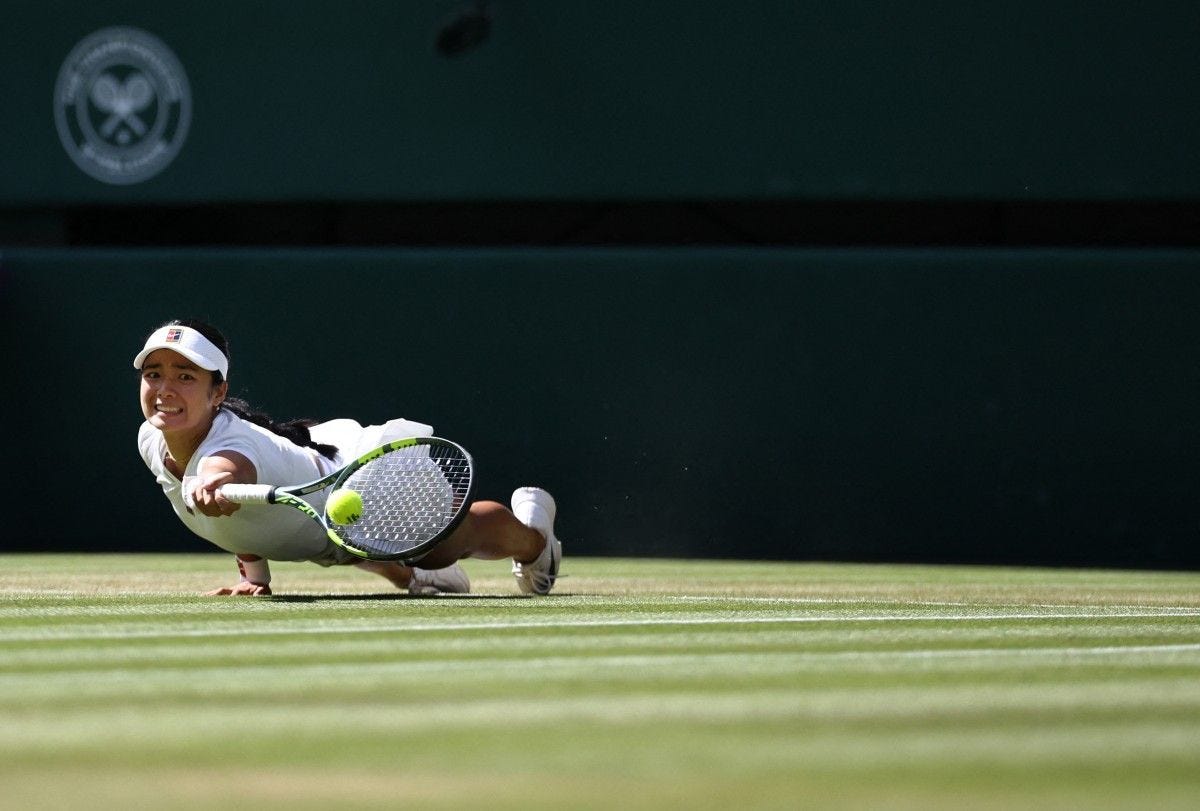
As humans, we’re oriented beings. More precisely, we’re future-oriented beings. We’re structured to aspire: we go to school because we want a degree; we want a degree because we want to land a good job; we want a good job because we want stability and security, and so on. All our actions are oriented to something or someone else, and dreams are precisely what give shape to how we orient ourselves. That’s why a person who stops dreaming risks losing her sense of direction—she no longer knows where she’s going, no longer knows what she wants. Alex is what that orientation looks like when it’s followed all the way through.
A cynic could argue that dreams are impossible fantasies. But aren’t impossible dreams what give our quest in life its thrill? Without dreaming, without hoping for something or someone, without aspiring to play and win at Wimbledon’s Centre Court, what else will feed our determination, grit, and daring? Most of our motivations are founded on our primal aspirations, what we most hope for in the deepest recesses of our inscrutable hearts. And it’s only with such dreams that we can begin to make real what is not yet but could be.
With a mix of much effort and a measure of luck, Alex fought against the odds of a more favored foe. But her triumph, which we all share, all started with that younger Alex’s willingness to dream. And that willingness to dream is something we can strive to imitate, because dreaming is one of the most human things we can do.