


I was recently asked a question I hadn’t expected to have an answer for: “What was the color of your childhood?”
I was quick to respond with yellow.
The sun’s warm glow, reflecting off the torn-out pavements of the familiar streets I had lived in all my life. The pencils I used to write stories with. The sticky golden spread on my toast and the rush to the obnoxiously yellow bus. Lemon-flavored lollipops. Balloons.
All in yellow.
It made small moments seem livelier than they were. The world felt brighter, and life’s colors appeared vibrant both to the eyes and to the childhood light within us. And then, as time went by, the vibrant colors changed, and those shades of yellow faded into something duller—something realistic, something limiting. As these hues evolved, we did too—we grew up.
The older we get, the more we talk of the past. Our parents’ classic phrase, “back in my day,” feels a little more sincere than simply being another way to follow their orders. Suddenly, we find ourselves saying the same thing as we look back on our lives, and in doing so, we experience a specific feeling: nostalgia.
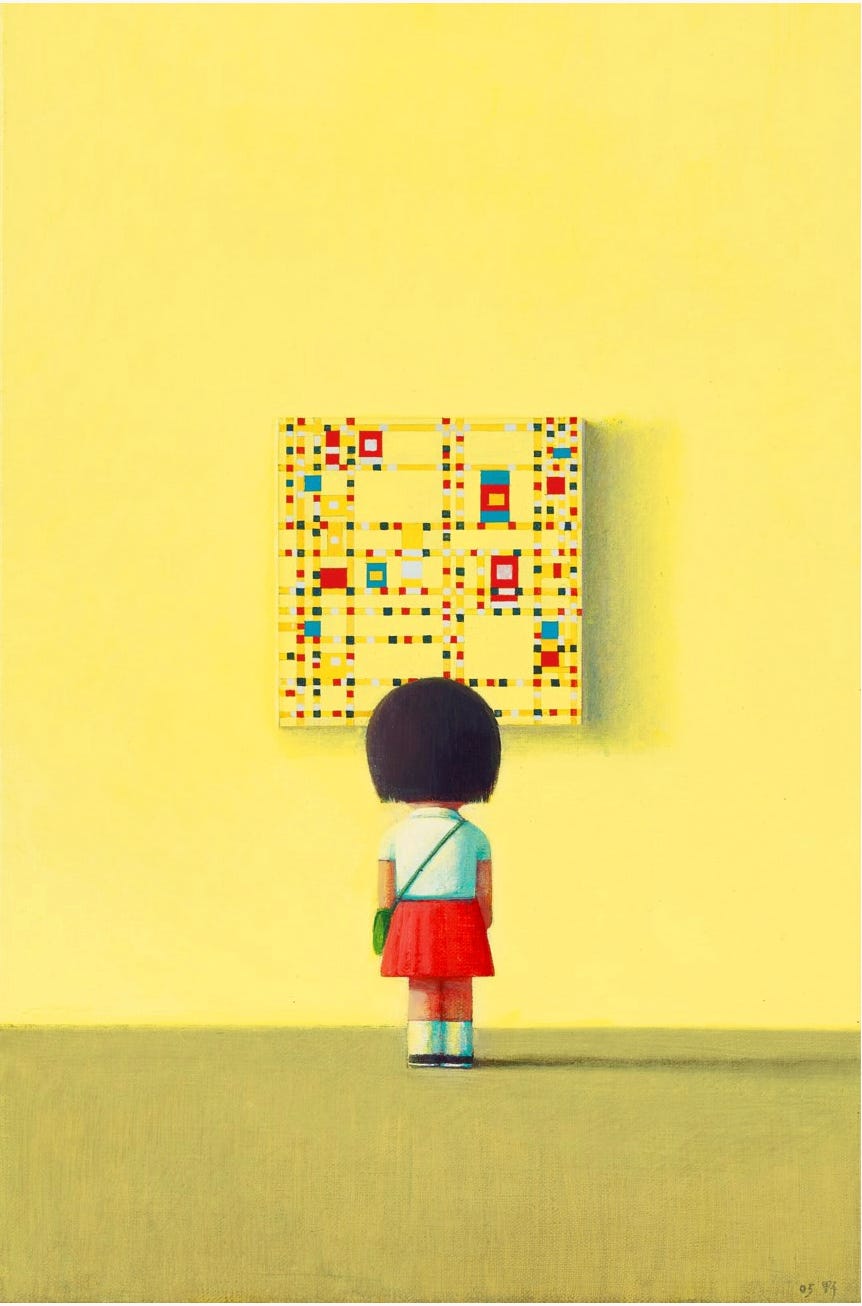
In the 17th century, physician Johannes Hofer coined the term nostalgia—derived from the Greek nostos (homecoming) and algos (pain)—which refers to the feeling of pleasure and slight sadness when you think about the past. This is true for many of us as we remember our childhood. We generally view it as a brightly-colored yellow, feeling more vibrant because it felt simpler to us, yet painful because of how distant it is now. The Childhood Illusion1 causes us to perceive our past brighter than it really was. This simplicity was not necessarily due to the world being better, but because we ourselves were simpler. My childhood felt brighter as responsibilities belonged to the adults in my life; my finances, future, and decisions were someone else’s worry. The simplicity of childhood gave me a space for curiosity and imagination to grow.
Imagination continues to play a large role in our lives today, just in a different way. The phenomenon called rosy retrospection2 is the tendency to remember experiences more positively than they actually were. We are biologically inclined to preserve the pleasant parts of the past while the pain of unpleasant experiences fades more quickly. In the brain, the hippocampus, which stores autobiographical memories, and the amygdala, which processes emotional experiences, work together to assign meaning to those experiences. Our memories are then not exact recordings but reconstructions of the past, built by our imagination.
Thus, our minds may hold our memories, but they constantly edit them. Memories are not always vivid; they are blurry, arriving only as fragments of what we once knew. It could come in the form of disconnected snapshots or a few words from a conversation. My high school musical experience exists in my mind much in the same way. I may not recall every practice, but I remember the chats I had with my classmates during the breaks and the full-circle moment when we left the stage. It lent a burgundy hue to the painting of my life, as the exhaustion and difficulty of being a seventeen-year-old reflected its dark yet rich tone. I can still see the residue of that burgundy color: scripts that creased under my fingertips from constant use and the songs that echoed in the hollow halls.
These sensory triggers act as vivid bridges to versions of ourselves that no longer exist, bypassing the blurry fragments of our conscious mind. Listening to “Nowhere to Go But Up” from Mary Poppins takes me back to the stage as I took my final bow beside my classmates. It reminds me of the seemingly endless preparations and the mistaken lines that became inside jokes. The exhaustion suddenly loses its weight, leaving me with the warmth of having gone through it together.
The bright yellow of my childhood and the deep burgundy of my high school days lent hues essential to the painting of my life. I recently stood across that canvas with a palette that felt dull and green-tinted. This green felt nauseating—a color for the refusal to let the present go. This is anticipatory nostalgia:3 missing the present prematurely before it has even become the past; a human rebellion against the fact that even as I live a special moment, I am already mourning its disappearance.
Anticipatory nostalgia carries a distinct duality. On one hand, it can be forward-facing and approach-oriented, encouraging me to savor the present as it unfolds, so that these experiences are captured for future recollection. On the other hand, it acts as an emotional distancing mechanism, causing me to mourn experiences before they even pass, which detaches me from my current state of mind and lessens my chances of enjoying the moments I am so desperate to cherish. Similarly, when nostalgia itself turns into idealization, it can convince one that the future can never match the past.
Therefore, the danger lies not in remembering the past, but in refusing to leave it. When we use the past as an escape from our current endeavors, nostalgia becomes a pathological discord from the present, trapping us in a state of suffering. By clinging to a version of reality that is dead and gone, we resist the changing nature of our existence. The favor for what has already passed conversely produces a preemptive sourness for what is to come—stripping oneself of the certainty and motivation needed to face the future.4 In contrast, using nostalgia as a restorative visit allows us to appreciate past versions of ourselves and to strengthen our sense of continuity and meaning. When we remain grounded in the present rather than being consumed by the fantasies of what has passed, nostalgia is a beautiful painting where every stage—from the bright yellow of childhood to the burgundy of our struggles—holds its own unique and necessary color.
So, look closely around you and try to observe every passing moment. Maybe the yellow never disappeared. The streets we walk on and the sun that rises every morning remain exactly as they used to be. The inherent joy and the world’s potential for vibrance never left.
As my painting shifts with each newly added color, it appears before me with more depth than ever. It is messy, it is complex. But it is art. Yellow represents my childhood—simple yet lasting joy. This darker shade of burgundy is the color of the passion I found when I stepped into the “real world” in high school. And only after learning to appreciate the present for what it is did I realize that the nauseating green had always been a beautiful emerald. I simply had to live—no longer chasing yesterday nor trying to outrun time—but witnessing the present as it unfolds to find its beautiful emerald shade. I had changed together with my painting. I continue to do so.
Nostalgia should not become a longing to stay in a version of the world that no longer exists, nor a longing for the people we once were, but rather a recognition of the life we have lived and the versions of ourselves that helped us arrive where we are today. And even now, at this very time and place, I paint with colors that my future self will one day long for.
Winer, Cottrell, and Weinbaum, “Developmental Changes in Understanding an Illusion Based on Perceptual Adaptation: Effects of Feedback,” December 1, 1993.
“Rosy Retrospection - the Decision Lab,” n.d.
Cheung, “Anticipated Nostalgia,” November 26, 2022.
Stolarski, Fieulaine, and Zimbardo, “Putting Time in a WiderPerspective: The Past, the Present and the Future of Time PerspectiveTheory.”

Great take on visual aspects of nostalgia! I actually never thought about what color my childhood felt like until you brought it up. Some questions were kind of left unanswered though. Is there a specific reason you used the color yellow for your childhood and burgundy for entering adulthood? I could not quite capture the presence of burgundy tbh. The entire article feels a little messy and lead by a string of thoughts instead of having clear fundamental elements. But maybe that highlights the nostalgic aspects even more. Couldn't really decide yet. Anyhow, good work.
Ayse I need more articles !!