


Self-expression has never been more threatened than it is today. When the modern-day individual is about to click “post,” try on new clothes, or adopt a certain lifestyle or aesthetic—in short, while discovering their identity—the internet steps in to intervene. A collective finger points across the feeds, and the modern age’s most devastating indictment is hurled: “larper!”
This is the current generation’s new favorite insult. Originally, the term—derived from the acronym “LARP”, which stands for live-action role-playing—simply referred to participants in costumed, theatrical hobbies;1 today, it is used to call out someone who is fake or accuse them of pretending to be something they are not—or so the internet declares.2 What was once a neutral descriptor is now a pitchfork for the angry mob, a tool for enforcing authenticity. In the 21st century, to become oneself, that is, to unfold one’s identity gradually but meaningfully, is to attempt to catch the wind.
So, how does one catch the wind?
Long before algorithms dominated our curated feeds, 20th-century French philosopher Jean Baudrillard already predicted the problem: weaponizing “larping” as an insult reveals an obsession with authenticity that is virtually unattainable. He demonstrated that we no longer inhabit a world of unmediated reality. Rather, we inhabit hyperreality—a condition in which reality and fiction seamlessly blend. Internet slang sits at the peak of this hyperreality. When we label individuals as inauthentic “larpers,” we replace the fluid reality of human growth with an impossible, hyperreal standard. That’s the comical crisis we find ourselves in today’s internet: everyone is a tragic victim of an “authenticity” that never existed.
As communication scholars note, digital platforms flatten the traditional boundary between the “front stage” persona, where a curated identity is performed, and the “back stage,” where that identity is privately rehearsed from public scrutiny.3 With the loss of those sheltered walls that once shielded a fledgling self from the swirling wind, an eternal audience watches every stage of human trial and error. Anything they deem unlikable is immediately condemned as “inauthentic.” So, this hyperreal authenticity instead works at our disadvantage; rather than permitting us to become something over time, it declares that we must be something—immediately at that, too.
When authenticity becomes this immediate obligation to perform, we encounter the irony of ironies: the internet mob has criminalized the exact mechanism through which humans learn how to live. By treating earnest exploration as fraudulent larping, they forget that human growth depends on mimesis4—the instinct to imitate before we embody—alongside adaptation and cellular turnover. Our skin sheds, and we are never quite the same as we were a month ago. As humans, we are built to outgrow ourselves.
Yet on the internet, there is no “authentic” person, only the hyperreal standards of one. We simply live in a society so terrified of its own artificiality that it polices the social landscape to protect an empty shrine. Thus charges the digital inquisition: those self-appointed, self-righteous hunters unconsciously shooting down beginners, genuine enthusiasts, and curious digital explorers with their biting bullets: “bro is larping as an influencer.”
The young internet explorer aspiring to become a social media influencer is criminalized for not meeting their expectations of having a certain number of followers. How sad, though, is the hunter’s bliss. The futility of trapping a moving, elusive wind; that is, the self is marked by its totalitarian desire for authenticity. They peel back one curated mask only to find another behind it.
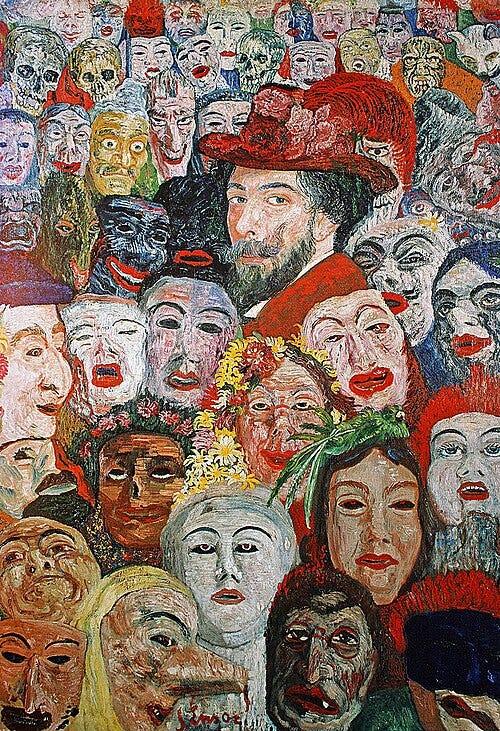
Furthermore, weaponizing “larping” betrays the inquisition’s own ignorance. In an ecosystem devoid of a private backstage, beginners are forced to rehearse their growth out in the open, raw wind of public scrutiny—“faking it” not to deceive, but “faking it till they make it” as an act of becoming. Larping becomes aspirational; to larp is to manifest a horizon of who one wishes to become. Thus, to dismiss this rehearsal as merely “fake” is to miss the point. In the digital sphere, larping has become the only surrogate backstage left. The larper’s willingness to explore freely without judgement indicates that there is no pristine, unmediated “authentic self” beneath anyone’s curated presentation; each is in the gradual process of discovering who we are. Terrified of this truth, the internet must therefore construct a spectacle so dazzling, it deters us from noticing that everyone is performing: the myth of authenticity.5 Here, Baudrillard gives us the tools to successfully diagnose this disease, but, by offering only critique without action, he also leaves us stranded in “the desert of the real”6 without a proper resolution.
To break free from this cynical dead-end, we look towards the Italian semiotician and novelist Umberto Eco and his solution. He does not deny Baudrillard’s diagnosis; rather, he accepts that static authenticity is dead and pivots to an alternative. In his preface to his collection Travels in Hyperreality, Eco reflects on years of writing essays for daily newspapers. He openly admits that his early writings often contradict his later ones, yet he refuses to edit away those contradictions. For Eco, writing is an attempt to capture the “wind”—that fleeting, immediate reaction to a changing world—rather than an absolute, permanent statement about reality. As Eco writes: I believe that an intellectual should use newspapers the way private diaries and personal letters were once used. At white heat, in the rush of an emotion, stimulated by an event, you write your reflections, hoping that someone will read them and then forget them.7
What Eco describes as the discipline of the writer is precisely what the internet’s self-righteous inquisition mocks as larping. The youthful digital explorer honestly trying an aesthetic or interest online is not a mere fraud to be ostracized, nor a passive victim condemned to be one fixed identity; they are Eco’s beginners trying to bottle the wind. In the same way that a cave explorer must let the winding caverns unfurl before charting a map, we must let identity speak for itself. Through the act of cartography, one arrests the elusive, fleeting notion of the self.8
Larping is this very art of cartography. It speaks of a desire to capture the fluid wind in prose and freeze it in time so that we might be understood. Hence, every text, post, and pixel carries this exact impulse to preserve a passing version of the self. Yet on the internet, this act of preservation carries the exhausting burden of “authenticity”. What should have been a temporary snapshot becomes a rigid mandate to follow. It forces us to post not as evolving thinkers, but as frozen atoms—experts who possess total knowledge and flawless finesse from day one. Under this digital policing, we become paradoxically less authentic. Denied the space to unfurl slowly or make mistakes in public, we are forced to perform instant perfection, terrified that any sudden gust of change will expose our inconsistencies. This is the invisible mechanism at work—the microbial, hidden, and filigree idol we call authenticity, inducing anxiety in us. And yet we are content to venerate him;9 we are content to perpetuate this problematic notion that identity is fixed. If obsessing over authenticity blinds us to our own performativity, then weaponizing larping as a policing method is but one cultural manifestation of this problem. Authenticity is threatened by the desire to be authentic.
Eco quietly reminds us that our task is to revolt against this banal system. This silent revolution can be achieved by simply beginning, in defiance of the internet’s lofty burdens. The anxiety to be is unwelcome wherever the writer takes the steps to simply become. The writer is simply a beginner, as the larpers of the internet are too.
It takes years to write an “academic” book, and then you have to wait for the reviews, and then correct your own thinking in the later editions. It is work that demands time, peace of mind, patience. I am capable of doing it, I believe, but in the meanwhile, I have to allay my anxiety.10
Indeed, reality as we want it to be may never be found, as Baudrillard believes;11 however, Eco tells us that it is simply unfolding instead. Through this process, we finally understand the flaw of the internet’s inquisition: authenticity ought to be a journey of discovery. Rather than simply being someone the world wants us to be, where exactly is this courage to become a person in today’s world? The world does not need more hunters; it needs more people—people who think like beginners, because they know they are one. Thus marks the task of the beginner: to become a process himself, so others may do the same.
Under this renewal of the mind, the elusive mirage of authenticity loses its glamour. The focus shifts away from condemning the larper to embracing them as a non-performative, holistic beginner. Reframing “larping” from a cardinal sin of inauthenticity to a necessary, awkward phase of human growth deprives the insult of its power. To try and fail, to experiment, or to change one’s mind over time is not deceit, but is instead the discipline of becoming. By embracing this mindset, we thus reclaim our right to unfurl our identities slowly and meaningfully. We stop policing others to protect an empty shrine, and we grant ourselves the grace to grow.
Alas, we have learned how to catch the wind—not by trapping it in a vault, but by capturing each passing gust, one bottle at a time.
References
Baudrillard, Jean. Simulacra and Simulation. Translated by Sheila Faria Glaser. Ann Arbor: University of Michigan Press, 1994.
Eco, Umberto. Travels in Hyperreality. Translated by William Weaver. San Diego: Harcourt Brace Jovanovich, 1986.
Goffman, Erving. The Presentation of Self in Everyday Life. New York: Anchor Books, 1959.
Hale, Rachel. “All of Gen Z is larping. It’s not what you think it is.” USA Today, August 10, 2026. https://www.usatoday.com/story/life/health-wellness/2026/08/10/gen-z-new-viral-insult-larping/91217937007/.
Manovich, Lev. Software Takes Command. New York: Bloomsbury Academic, 2013.
Marwick, Alice E., and danah boyd. “I Tweet Honestly, I Tweet Passionately: Twitter Users, Context Collapse, and the Imagined Audience.” New Media & Society 13, no. 1 (2011): 114–33. https://doi.org/10.1177/1461444810381864.
Meltzoff, Andrew N. “Born to Learn: What Facial Imitation Tells Us About the Mind of the Baby.” Cognition 72, no. 1 (1999): 1–25. https://doi.org/10.1016/S0010-0277(99)00029-4.
Merriam-Webster Dictionary. S.v. “LARPer.” Accessed October 18, 2026. https://www.merriam-webster.com/dictionary/LARPer.
Merriam-Webster Dictionary, s.v. “LARPer,” https://www.merriam-webster.com/dictionary/LARPer
Rachel Hale, “All of Gen Z is larping. It’s not what you think it is.”: “[A larper is] someone who is performative in the way that they're dressing or acting or doing something, and it's not actually authentic to who they are as an individual.”
Context collapse is the flattening of distinct social audiences into one, single, shared digital space. A single post, tweet, or video can reach unintended viewers who lack the backstory or shared norms to understand the original context the media situates itself within. Thus, misinterpretation often arises, subsequently leading to social friction or backlash. For more on the dramaturgical identity performance and the collapse of the “back stage” in digital spaces, see Erving Goffman, The Presentation of Self in Everyday Life (Anchor Books, 1959); and Alice E. Marwick and danah Boyd, “I Tweet Honestly, I Tweet Passionately: Twitter Users, Context Collapse, and the Imagined Audience,” New Media & Society 13, no. 1 (2011): 114-33.
Derived from mimeisthai, meaning “to imitate,” mimesis refers to the imitation, representation, or reproduction of aspects of the real world, especially on human action, nature, and behavior. Aristotle in his Poetics argued that imitation is natural to human beings, a primary way people learn and process reality. Cognitive science further suggests that it is how human children learn. Cf. Andrew N. Meltzoff, “Born to Learn,” Cognition 72, no. 1 (1999): 1-25.
Deterrence refers to the process wherein a systemic construct is designed to distract and deceive people into thinking the real exists when it has already disappeared. Because we inhabit the hyperreal so comfortably, we no longer notice the total liquidation of the real. It is a strawman fallacy that proves the real through the imaginary. In this essay, I argue that deterrence is being used to postulate that an unmediated, pristine “Authentic Self” still exists out there somewhere; whereas, identity and authenticity should be treated as a narrative process cultivated over time. Cf. Baudrillard, Simulacra and Simulation, 5–7, 12-14, 27-32.
Baudrillard, Simulacra and Simulation. 1.
Umberto Eco, Travels in Hyperreality, x.
The concept of the “punctual I” is the concept of the self as a purely formal, disengaged mathematical point. The self is not an object you can find or touch within your mind; it is simply the logical point or node where the continuous field of reality is synthesized into conscious awareness.
Baudrillard, Simulacra and Simulation. 5.
Eco, Travels in Hyperreality. xii.
Baudrillard is heavily skeptical of anything being the true reality. As far as he was concerned, reality was, is, and will remain fully inaccessible to human experience. Cf. Simulacra and Simulation. 3-9, 45-47, 143-145.
