


By Zach Reyes
Universitas Staff
It is as familiar as it is human to be thrown into the morning of a new day. In that fresh daze, the mind must arrange its agenda and latch onto that. When it does so, it becomes common to filter everyday experiences, but it becomes uncommon to imagine the experience of arising from bed in the conscious body of a gigantic beetle. Only the German-speaking Jewish writer and novelist, Franz Kafka, has done both simultaneously.
Readers of Kafka will mark him as having championed the uncanny, that is to say, he has achieved this seamless blend between surreal premises juxtaposed with mundane tasks familiar to human experience. This uncanny confrontation of the mundane with the surreal is best exemplified in his most famous work, The Metamorphosis.
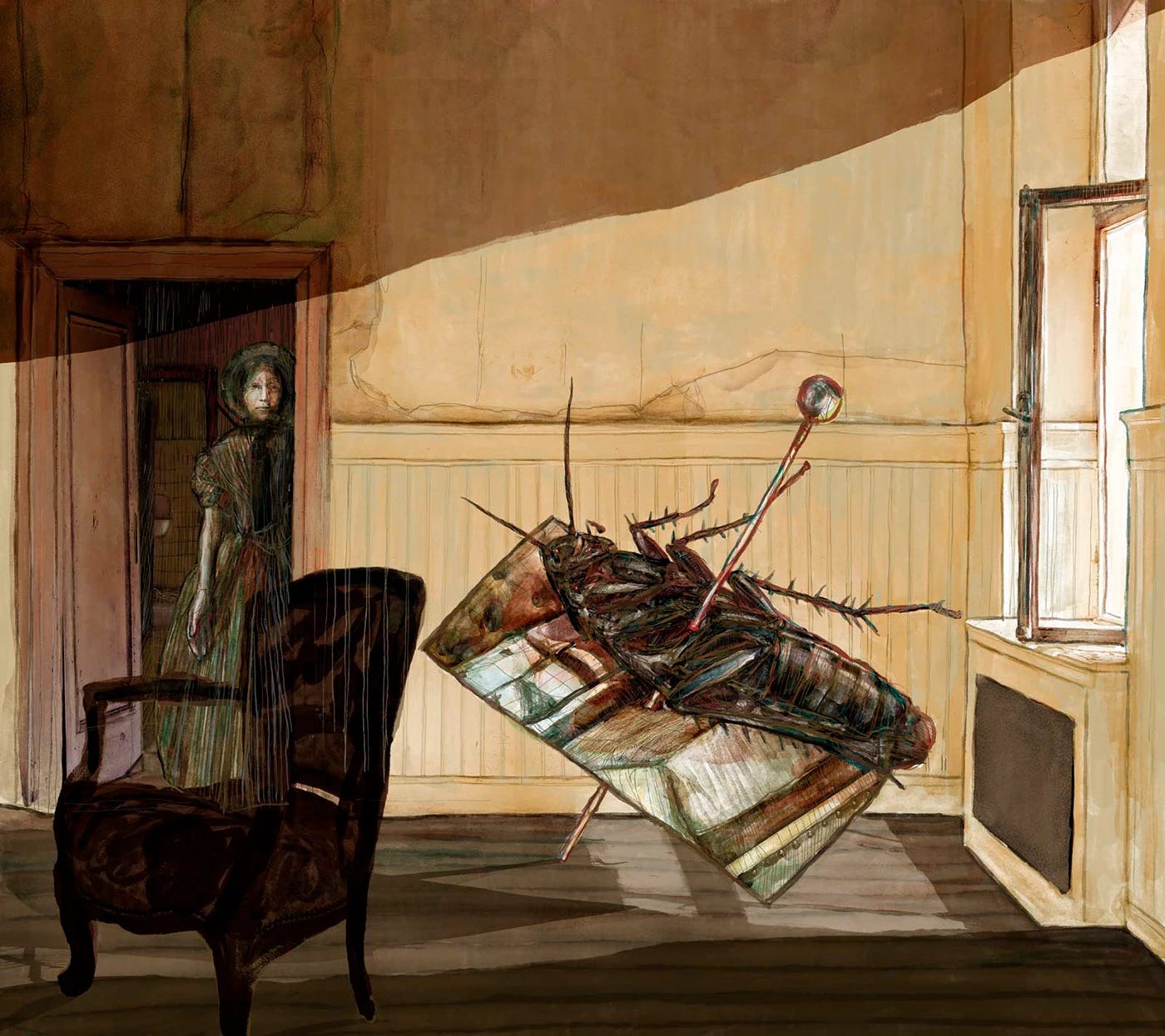
The premise of his seminal novella is as simple as it is absurd: Gregor Samsa, a young traveling salesman and the sole breadwinner of his family, wakes up one morning to find himself transformed into a giant beetle-like insect as he and his family navigate the implications this bears on their financial situation. There is no grand narrative beyond this. Kafka’s chief concern is to unpack the social and existential horrors it must be for the protagonist to live with such a surreal disability. Thus, when Gregor has metamorphosed into that monstrous vermin,1 he is less worried about such an absurd fact than he is about the issue of getting to work on time to provide for his family. Kafka writes:
“Oh God,” Gregor thought, “what a grueling job I’ve picked! Day in, day out—on the road. The upset of doing business is much worse than the actual business in the office, and besides, I’ve got the torture of traveling, worrying about changing trains, eating miserable food at all hours, constantly seeing new faces, no relationships that last or get more intimate. To the devil with it all!”2
When he is visited by his boss and family, and thus his new insect form is revealed, there is no compassion to be found. He is forcefully shoved back into his room and evidently fired from his job as a traveling salesman. It is then that the true allegorical metamorphosis begins.
Tragedy does not strike when Gregor has metamorphosed into a vermin; it strikes when Gregor has done so while remaining fiercely human. In other words, Gregor is entirely conscious of what is happening. Moreover, this is most aptly manifest when his loved ones treat him as contrary to a human. To stay in one’s room all day is torturous enough, but to be visited only by one’s sister—for the sole purpose of being fed—is when alienation encroaches. Irrefutable proof of such an alienation is found when his sister is obligated to dispose of his leftovers. She does not simply pick them up with bare hands, but with a rag. In this way, Gregor is “untouchable,” such that he is a twisted pet. He becomes the object of a chore because he is a burden no one chooses. While not explicitly stated by any of his characters, Kafka is clever in weaving descriptions that evoke these images of imprisonment.
Gregor heard him [his father] open the complicated lock and secure it again after taking out what he had been looking for […]. These explanations by his father were to some extent the first pleasant news Gregor had heard since his imprisonment.3
Gregor is now no longer just a pet; he is a prisoner. He is a prisoner of his own household and its conditional, warped, forced “love.” Like a prisoner, however, he yearns for freedom and denies the idea of being a pet. To spare his family his monstrous form, he carries a sheet on his back to the couch and arranges it so that he is completely covered up. Now, shame riddles him. Gregor covers himself because he internalizes his family’s disgust. By hiding, he attempts to escape being reduced to a horrific object and thus desperately attempts to reclaim privacy—a human freedom of some tragic sort—from the gaze of his family. However, shame persists. Here then is the bitter reality: We, the “I”, can never escape from the other. Whether Gregor covers himself or not, he is perpetually subject to the validation of his family. Consciousness implies an intentionality.4 It is here that Gregor the “untouchable” is now “invisible” as well. Nevertheless, Gregor the “invisible” is a Gregor who is ruthlessly felt.
At the heart of this ruthless shame lies the inversion of duty: Gregor’s irretrievable duty to support his family results in the family’s begrudging duty to love Gregor regardless. It was a duty that,
In spite of his present, pathetic, and repulsive shape, who could not be treated as an enemy; that, on the contrary, it was the commandment of family duty to swallow their disgust and endure him, endure him and nothing more.5
A duty to love Gregor, however, would only surpass insofar as they regard the metamorphosed insect cohabiting their house as beloved Gregor. By unleashing a discourse on dignity, Gregor’s sister attempts to justify her decision to stop caring for him:
“It has to go,” cried his sister. “[…] You just have to try to get rid of the idea that it’s Gregor. Believing it for so long, that is our real misfortune. […] How can it be Gregor? If it were Gregor, he would have realized long ago that it isn’t possible for human beings to live with such a creature, and he would have gone away of his own free will.6
Notice her refusal to utter Gregor’s name in the revolting presence of what they think is no longer him: it is the complete withdrawal of any dignified love. No longer is Gregor a pet nor a prisoner; he is a parasite. To his sister, Gregor is unbearably selfish because she considers just existing to be selfish. Consequently, and to everyone around him, Gregor is simply an “it”. The caustic irony, however, is that Kafka suggests otherwise. In fact, Gregor does exactly what his sister suggests a “real” him would do: upon hearing his family pronounce him a burden and wish him gone, it becomes Gregor’s duty to retreat to his room in order to relieve their suffering. Indeed, Gregor has “gone away of his own free will,” for if his actions and sentiments imply a dutiful, that is to say, conscious “I” embedded within the monstrous vermin, so too does that verdant humanity imply a dignity of the beloved.
Thus, if indeed nothing more lies beyond the veil of duty, a profound question lies at the crux of Kafka’s novella: if love is a duty, can it even be called love? What more twisted has this “love” become than a human’s corporeal nature being twisted into a bug’s; perhaps this is the allegorical metamorphosis we find. Nevertheless, Gregor’s body is loosely human as it is a husk. However, his intentional attempts to reclaim a semblance of human freedom prove otherwise. Humanity and the dignity therein are an indivisible fact of the human vis-à-vis insect separation underlying Gregor’s bodily metamorphosis. A post-metamorphosis Gregor then is one who has lost any outward semblance of a human being, yet because of this, unraveled, in its utmost depth, what it is to be human.
Love cannot be encapsulated as mere duty because love is a duty insofar as it is also a choice. Love does not persist when duty becomes a chore; love persists when we decide to express what is fiercely human. Moreover, it is when we are reminded of the dignity others have to be loved that love persists. While Kafka’s The Metamorphosis is often interpreted as an allegory for the horrors of disability and the consequent pangs of alienation, it is also a profound meditation on what it means to be human and what that dignity entails regardless of any metamorphosis. One can blend both to see that humanity transcends disability, so that the next time we find ourselves met with a friend or family member who finds themselves feeling like a monstrous vermin—that through their desired ascent to be loved—are nevertheless still human.
To weave this insight under the ravaging mundanity of financial struggles makes Kafka’s writing distinctively uncanny. His prose is deceptively simple; he laces nightmarishly surreal premises with cold, clinical precision. Realistic characters, like Gregor, confront unrealistic situations with a terrifying immediacy, but ultimately reveal a realistic humanity.
When Gregor Samsa woke up one morning from unsettling dreams, he found himself changed in his bed into a monstrous vermin.7
It is as familiar as it is human to wake up feeling the opposite of human. In that overlooked daze, the person thinks he is a monstrous vermin. When he thinks so, it becomes common to seek humanity, but it becomes far from common to imagine this desire arising from the conscious body of a gigantic beetle. It could only be the German-speaking Jewish writer and novelist, Franz Kafka, who has put humanity at stake for us to ponder.
In the original German, Kafka deliberately used the term “ungeheures Ungeziefer,” roughly translated as “unclean animal not suited for sacrifice” to describe Gregor Samsa. While often visualized as a beetle or a cockroach in English translations of the text, Kafka simply employs an ambiguous term to highlight the themes of disgust and alienation. I have used the Stanley Corngold translation which attempts its best to replicate that visceral disgust.
Franz Kafka, The Metamorphosis, 3-4.
Ibid, 25. Three words here superbly evoke Kafka’s atmosphere of imprisonment: complicated lock, secure, and imprisonment.
In German philosopher Edmund Husserl’s phenomenology, he develops intentionality as the principle that “consciousness is always a consciousness of something.” The implication present here is that there is no such thing as a free-floating consciousness in a sealed container.
Franz Kafka, The Metamorphosis, 38.
Ibid, 49.
Ibid, 3.
References
Kafka, Franz. The Metamorphosis. Translated and edited by Stanley Corngold. New York: Bantam Books, 1972.