

By Dr. Antonio Torralba
When Blessed Alvaro del Portillo visited what was then the Center for Research and Communication (CRC), he reminded Dr. Jess Estanislao, Dr. Bernie Villegas, and Mr. Henry Esteban that Saint Josemaría had asked them to put up a university—not a center or graduate school.
From 1987, the work on the university began.
Ricardo Gloria, Head Commissioner of the Commission on Higher Education (CHED), set three conditions for CRC to be converted into a university: that there be 40 PhDs affiliated with CRC; that at least four programs be accredited; and that CRC have a track record of four years of research in an academic journal.
The 40 PhDs were realized by gathering the consent and signatures of PhD holders within CRC and people from the Department of Education and universities who had been invited to give talks and lectures at CRC for its existing programs: the Master of Arts in Values Education, the Master in Business Economics, and the Applied Business Economics Program.
The four-year research track record was fulfilled by printing, within a period of two months, a compilation of research work from CRC’s founding. The journal was called Synergeia—the Greek word for “synergy.”
The accreditation of the programs was carried out through PACU-COA (Philippine Association of Colleges and Universities – Commission on Accreditation). PAASCU (Philippine Accrediting Association of Schools, Colleges and Universities) was not sought because UA&P is not a Catholic university by claim or by structure. PACUCOA sent five accreditors, and by sheer providence, God placed people in the right spots for the conversion of the university. Within a few months, the programs were accredited. By the first quarter of 1995, one year after the birth of CHED, CRC had already met all the qualifications to become a university.
With the three conditions met, the five commissioners unanimously agreed to declare the conversion of CRC into a university.
The date Dr. Jesus Estanislao had wanted for the charter date was June 26—the heavenly dies natalis of Opus Dei’s founder, Josemaría Escrivá. But the date was hard to attain: Secretary Gloria was in Mindanao. When Gil Gonzalez, assistant to Dr. Estanislao, called Secretary Gloria’s office on June 26, he was told that the Secretary was out of town but would be arriving that afternoon. So Jess Estanislao and Gil Gonzalez went to Villamor Air Base. The helicopter landed at around four o’clock.
Dr. Estanislao approached Secretary Gloria. “I have here the possible charter of the university. We were wondering if you could sign it.” There was to be a photo opportunity, but Gloria raised a concern: “I have a problem—I’m only in batik, and you are in coat and tie.”
Dr. Estanislao was on his way to Manila Cathedral for the Mass for then-Blessed Josemaría Escrivá.
“Well, that’s not your problem,” he replied. “It’s mine.” He removed his coat and tie, and the photo was taken as Secretary Gloria signed the charter in his batik.
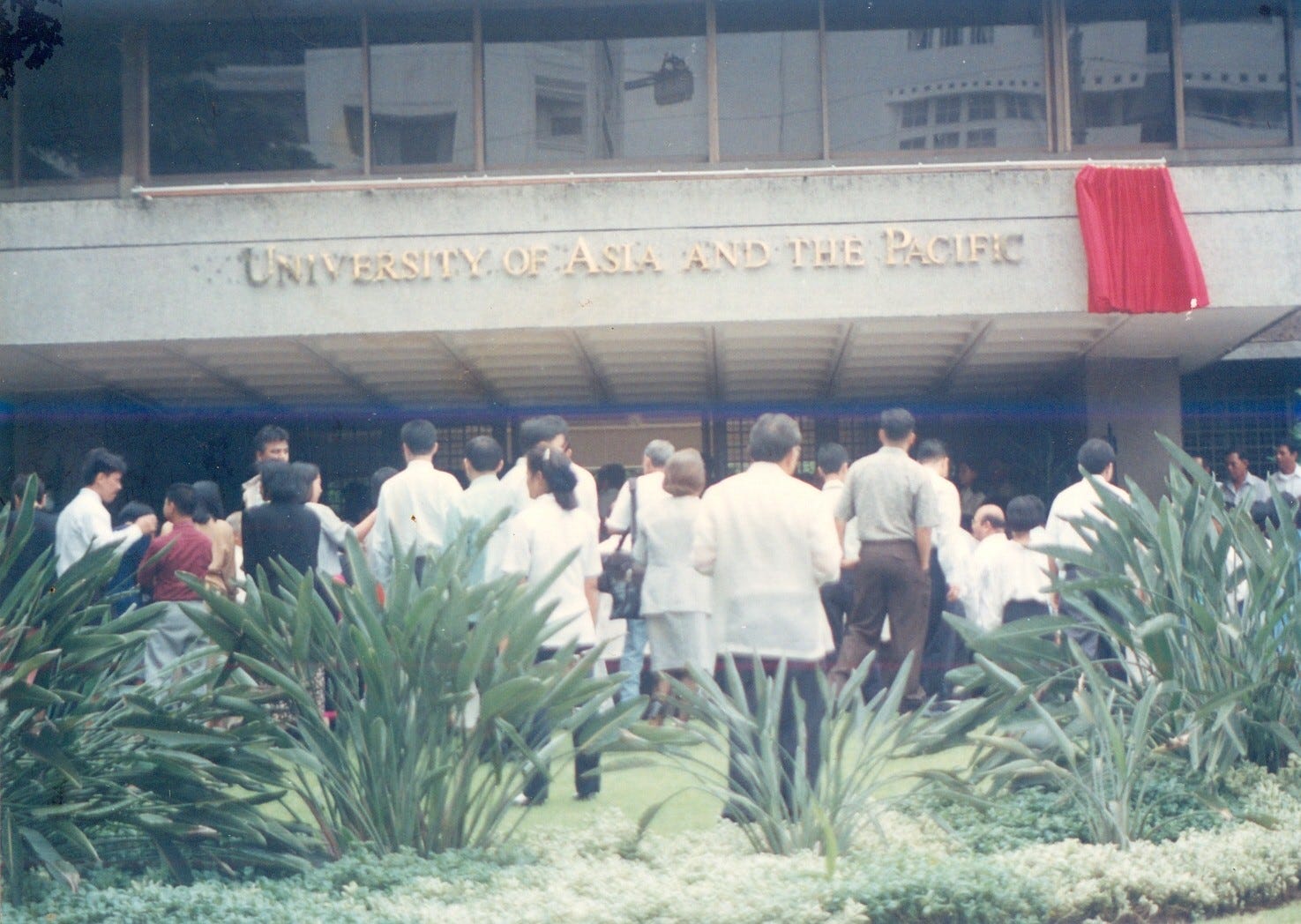
A few days after the university was officially declared before an assembly of faculty and guests from different universities, all in academic regalia. After Secretary Gloria’s address, the CRC flag—which still exists today—stood before the front curtain of the venue, Celestino Dizon Auditorium. Two students from the student council ascended the stage from either side of the staircase, lowered the flagpole, and removed the CRC flag ceremoniously. As the curtain opened, the tapestry of the University of Asia and the Pacific came into view.
That is the brief story of the beginning of UA&P, whose Charter Day we celebrate on the Feast of Saint Josemaría. It was providential that the charter was signed on his feast day itself. Looking back on the decades since—watching CRC grow into UA&P—I’m certain that everything was the work of our Lord. Everything was in God’s hands.