


How does one say the phrase “in spite of everything”?
It sounds easy enough to pronounce. With enough roaring declamation, the words shall come crashing down like divine inspiration. But that is not the pronunciation I look for; I mean something else entirely. I mean the quiet yet radical act of someone saying these words after gazing into the void of hopelessness, and yet, in spite of that, decides to utter them. I mean the words said with utmost conviction; an incendiary tone that solicits a profound emphasis on what it means to live anyway.
In my initial thoughts of The Mind Against the Storm, I explained this feeling.
“The sublime is that aesthetic experience derived from encountering phenomena so immense that they induce terror at first, only to ultimately awaken the person to a higher state of living and moral strength.”
How peculiar is it that we can derive something so positive from feeling something negative at first? Yet, within the sublime lie those four fabled words. In the same way that one can endure a fate so mundane, one can still feel something sublime.
Consider the everyday horror: sitting still in a traffic jam during a tropical downpour, powerless against the indifferent metropolis and its beating neon heart. Yet, in spite of this standstill, something loftier arises: a genuine conversation and a moment of laughter shared with the passenger beside them. Therein lies the triumphant joy in running counterflow against the ebb of traffic; to refuse bitterness is to revolt through moral reflection. For the philosopher, Immanuel Kant, this capacity is precisely what allows humans to overcome nature.
In the same way, though the irresistibility of nature’s might makes us, considered as natural beings, recognize our physical impotence, it reveals in us at the same time an ability to judge ourselves independent of nature, and reveals in us a superiority over nature […]. This keeps the humanity in our person from being degraded, even though a human being would have to succumb to that dominance of nature. Hence, if in judging nature aesthetically we call it sublime, we do so not because nature arouses fear, but because it calls forth our strength.1
There is a distinct, lofty pleasure in realizing one’s spiritual strength in spite of everything. Even more sublime is the feeling when one arrives at this from the horrors of something so mundane. We often associate the sublime with grandeur and immensity—raging oceans, towering thunderstorms, or the cold expanse of outer space. Indeed, astronauts have illustrated this experience through what is known as the overview effect.2 Beholding the Earth against the void of space renders the astronaut small, powerless, and fragile, yet it renders vivid and whole humanity’s shared condition on this pale blue dot.
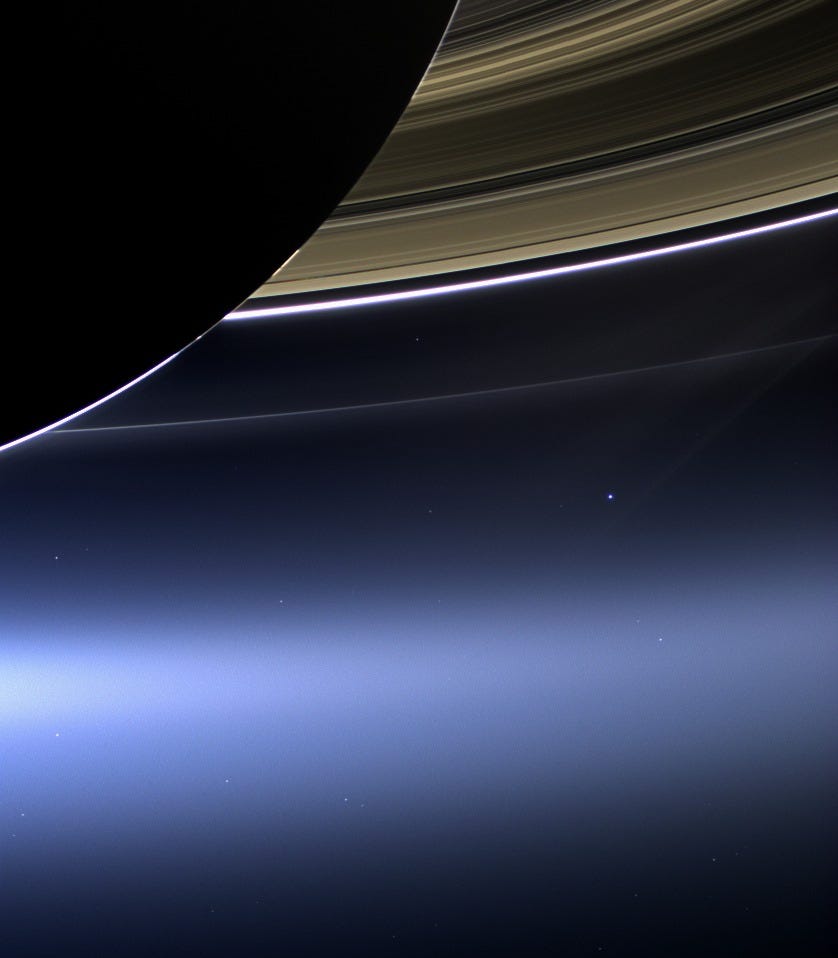
Cassini’s Pale Blue Dot, photo from NASA/JPL-Caltech/Space Science Institute, 2013, July 23 — Source
As NASA astronaut Victor Glover noted upon returning to Earth:
“You come back to sea level, and then you have a choice,” he explained. “Are you going to try to live your life a little differently? Are you going to really choose to be a member of this community of Earth?”3
Notice, though, where the epiphany completes itself: not in orbit, but at sea level.
Realization is only half of the sublime; true sublimity requires a return. The overview effect offers a momentary glimpse into vastness. After that glimpse, the astronaut returns to Earth. If he stays floating in that cosmic abyss, he is confining himself to pure terror, defeat, and nihilism. We are therefore called to see beauty in the knowledge of what lies beyond mankind, and, faced with the limits of human understanding, decide to live anyway. In spite of the unknowable, one finds the sublime in knowing that this same triumphant resolve can be shared with others. Thus, mankind is a united speck. We are alone in this universe, yes, but we are alone together. Awakening each other to higher states of living, we are the sublime.
Hence nature is here called sublime merely because it elevates our imagination, making it exhibit those cases where the mind can come to feel its own sublimity, which lies in its vocation and elevates it even above nature.4
That is why the astronaut ought to return; he must bring the sublime home. It does not belong in space, but rather to us—fellow mankind.
Thus, the sublime becomes joyfully manifest when one who is battered and exhausted by the week stops to look at a breathtaking sunset, bleeding through the grey clouds, and chooses to live another day. After that initial dread, he remembers those four fabled words and makes a choice; while being human entails being easily broken and battered, this does not break their resolve. The resolve we find here is one of irrefutable joy and a rapture of indomitable spirit—of triumph over fragility.

Crepuscular Rays over the City, photograph by Zach Reyes, 2026, October 19.
Fragility becomes more than a defect of human existence; it is the exact condition for the sublime. A human sublime is found in choice, in revolt, and in spite. In spite of personal grief or systemic injustice, one can always choose kindness over bitterness. It is because of this that humanity lives in spite; we stare at the abyss and carve our own home out of it. Humanity also lives through spite; we choose the triumph of living anyway in spite of its shadowy counterparts.
To live by the sublime is thus to realize that light and shadow are inseparable. Every light casts a shadow, so that light calls itself a “light” at all. The point is to recognize the fundamental balance between the two opposites, and understand that without the conventional “good” and “bad,” there would be no sublime. One does not similarly need to orbit the Earth to find something worth living for. One needs only the courage to face the horror in the mundane and everyday chaos, the injustice of the world, the irreverent neon pulse of traffic, and declare with an utmost conviction and incendiary tone those four fabled words—and in a surge of quiet defiance, tack on five more:
“In spite of everything, I found something to live for.”
References
Grimm, Linda E. “The Overview Effect: Astronaut Perspectives from 25 Years in Low Earth Orbit.” NASA. Last modified November 23, 2025. https://www.nasa.gov/centers-and-facilities/johnson/the-overview-effect-astronaut-perspectives-from-25-years-in-low-earth-orbit/.
Kant, Immanuel. Critique of Judgment. Translated by Werner S. Pluhar. 1790. Reprint, Indianapolis: Hackett, 1987
Immanuel Kant, Critique of Pure Judgement, 120-121.
Linda Grimm, The Overview Effect.
Ibid.
Kant, Critique of Pure Judgement, 121
