


By Bernardo Villegas
Co-Founder, University of Asia and the Pacific
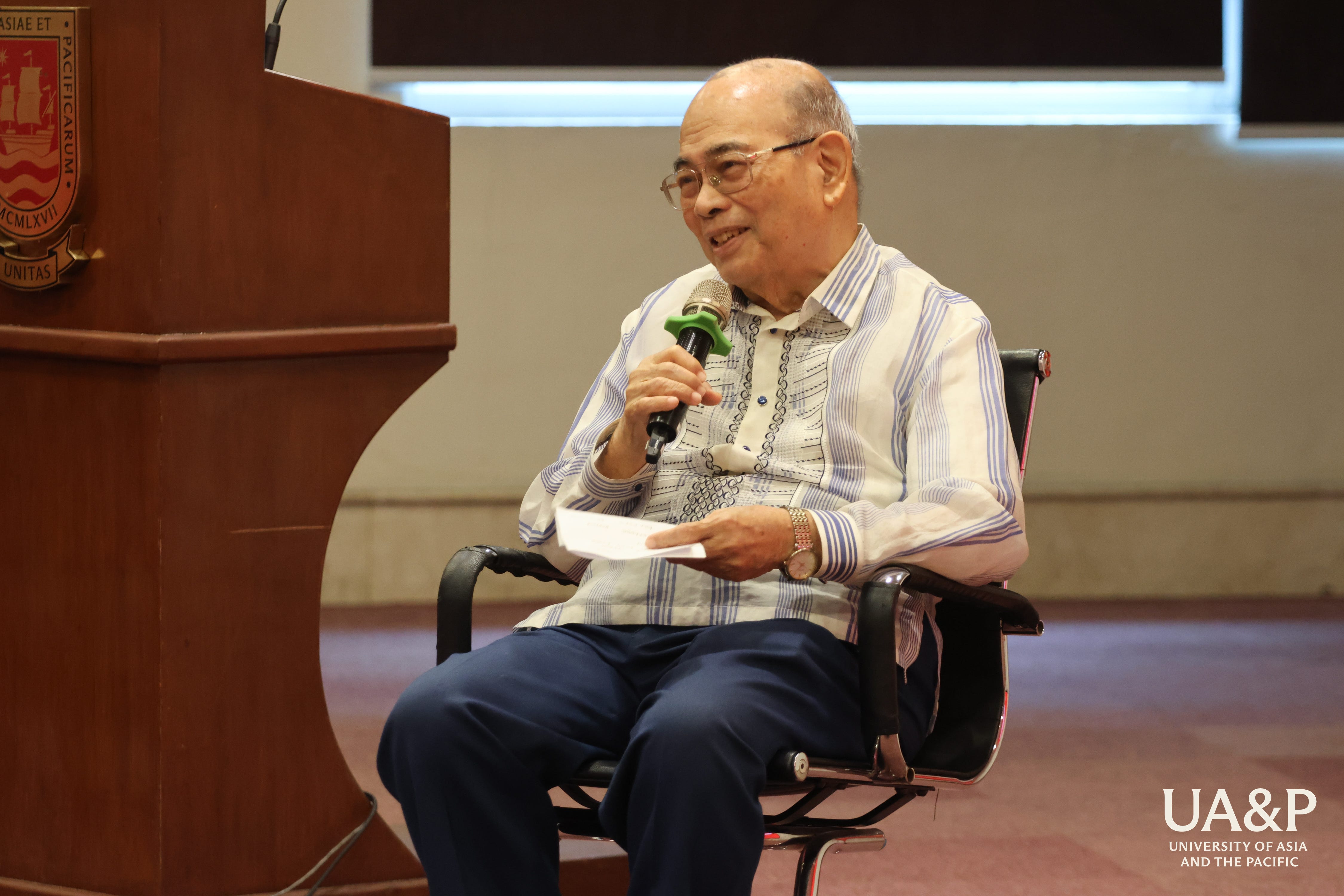
I am a pre-baby boomer (those born between 1946 to 1964) since I saw the light of day in 1939 just before the Japanese occupation of the Philippines and the U.S.-Japan war in the Pacific. As a life-time educator, I take it upon myself to continue educating, forming and mentoring all the generations after me. That is why, I was very glad that some professors from my university, the University of Asia and the Pacific (UA&P), organized what they called a “Magisterial Lecture” to all the first year students of the university last November 4. These 18- year-old men and women are part of Generation Y or the Millennials (born between 1981 and1996) who came of age around the turn of the millennium, forming the bridge into digital technology and shaped by the rise of the internet and the 2008 Great Recession. Having lived through the last three generations before theirs, I take it upon myself to make sure they will learn from the errors of their grandparents and parents that led to the Philippines being known as the “Sick Man of Asia” during most of their forebears’ lifetime.
The baby boomers were those who led the Philippines to take the first steps in both political and economic development during the decades of the sixties and seventies. The political missteps and abuses of those who played an important role during the martial rule regime of the seventies and eighties are well known. I will not discuss them here. What I want to describe briefly for the enlightenment of the Generation Z or Zoomers (born 1997 – 2012) and the Alpha generation (born 2013 – 2024) are the errors in economic policies and failures to build strong institutions that characterized the decades of the sixties and seventies so that future generations will not make the same mistakes.
First, I informed my young audience of the well known fact that in the 1950s, after we were granted political independence by our former colonizer—the United States—the Philippines was considered to be at the forefront of economic development in the whole of East Asia. We were considered only second to Japan in potentials for long-term economic progress. We had one of the highest rates of literacy and GDP per capita. Fast forward: by the decade of the eighties, we were at the bottom of the list in per capita income in East Asia, surpassed especially by the four tigers of East Asia, i.e. Singapore, Taiwan, HongKong. What was the first major error in economic policy that the baby boomers committed? We failed miserably in the area of industrial policy, which refers to deliberate actions taken by a government to develop, strengthen, and modernize particular industries and productive sectors of the economy. Its main purpose is to transform the structure of the economy (say, from a predominantly exporter of raw materials to a manufacturing-based economy) by encouraging investments in the appropriate sectors, increasing productivity, creating higher-quality jobs, developing technology, and making domestic industries more competitive.
In simple terms, industrial policy is about deciding what industries a country should develop, why they should be developed, and what the government should do to help them succeed. It has nothing to do with the government owning or opening factories. Rather, it is often about creating the conditions that encourage private businesses, both domestic and foreign, to invest in strategic industries with the greatest multiplier effects on income growth and employment. The main instruments of industrial policy involve investment incentives, such as tax incentives, investment allowances, and other benefits to encourage companies to establish factories and industrial facilities; infrastructure development such as building reliable electricity systems, roads, ports, railways, industrial parks, water facilities, and telecommunications; education and skills development, e.g. training industrial workers and engineers to meet the requirement of modern industries, etc.
Unfortunately for the Philippines, the baby boomers were so blinded by the fear of being recolonized by the United States, no longer through political control, but through an overdependence of the economy on foreign investments. Thus, started a long period of ultra- nationalistic industrial policy that limited foreign ownership of Philippines industries and an emphasis on inward-looking, protectionist industrialization. One successive government after another used investment incentives like a strong peso, subsidized interest rates, high tariffs on consumer imports to make capital-intensive, import-substitution industries artificially competitive. This was in great contrast with the export-oriented, labor-intensive industrial policy followed by its East Asian neighbors, like Singapore, Hong Kong, Taiwan and South Korea that wisely used the abundant labor forces that resulted from the baby boom after the Second World War in manufacturing consumer goods for export to the developed markets in the U.S. and Europe. This introduced a manufacturing culture in these “tiger economies” that they used to eventually graduate to more capital-intensive industries which they were able to fund with their abundant savings. The capital-intensive, inward-looking and import-substitution industries with which the Philippines started its industrialization efforts died natural deaths during the era of globalization. This explains why the Philippine manufacturing sector was, so to speak, still born. At this late stage of its development process, Philippine manufacturing—which is the most vital sector for improving over-all productivity of the economy—continues to be an insignificant percentage of its GDP (15 % compared to an average of 25 to 35 % among its neighbors in East Asia).
An even more fatal mistake of the political leaders from the generation of the baby boomers was to give very short shrift to agricultural and rural development. Some of them even explicitly stated that agriculture was an inherently backward sector and does not deserve a high priority in the budgeting process. The result of this world view was a serious underinvestment in farm-to-market roads, irrigation and post-harvest facilities, agricultural extension services and credit to the farmers. Things got even worse when, with all the good intentions, the Comprehensive Agrarian Reform Program (CARP) was introduced during the last quarter of the 20 th Century. Millions of hectares of farms were split into small parcels of two to three hectares each and parceled out to millions of small farmers, especially in the rice, coconut and sugar industries. There was nothing inherently wrong in this measure demanded by social justice, which was also implemented by its more progressive neighbors like Taiwan, Thailand, and Vietnam. What went terribly wrong was the lack of follow through. The farmer beneficiaries were left totally on their own: no farm-to-market roads, no irrigation, no agricultural extension, no credit to farmers, etc. The Philippines has the lowest farm productivity in all these three crops that are of great importance to food security and export earnings. A related error of omission of baby boomers was the underinvestment, not only in farm-to-market roads, but also in physical infrastructures in general. While most of its neighbors were investing some 5 to 6 % GDP in infrastructures, the equivalent figure in the Philippines was 2 to 3 %. It was only during the Administration of President Rodrigo Duterte that this percentage reached 5%. Great expectations are pinned during the decade or so on what is called the Luzon Economic Corridor, a conditio sine qua non for the much heralded Pax Silica.
To be continued.