“I went to the woods because I wanted to live deliberately, to front only the essential facts of life, and see if I could not learn what it had to teach, and not, when I came to die, discover that I had not lived. I did not wish to live what was not life, living is so dear; nor did I wish to practise resignation, unless it was quite necessary. I wanted to live deep and suck out all the marrow of life, to live so sturdily and Spartan-like as to put to rout all that was not life, to cut a broad swath and shave close, to drive life into a corner, and reduce it to its lowest terms.”
– Henry David Thoreau, Walden: Or, Life in the Woods
Spoiler alert: The following article discusses major plot points of The Dead Poets Society movie.
Have you ever been told to chase a realistic goal? That your hard work today promises a brighter tomorrow? While there’s truth in that, how often did you stop to think about what that brighter future actually looks like for you? Living in the present is harder than ever, with the constant talk about prioritising your future. The movie Dead Poets Society (1989) presents to us life at Welton Academy.
Tradition, Honor, Discipline, and Excellence.
In 1959, these four pillars defined life at Welton Academy, one of the finest preparatory schools in the United States, located in Vermont. These rigid ideals are intended to mold young men into honorable and functional members of society. Yet, beneath the academy’s prestige lies an institution less concerned with cultivating new ideas than it is with training young men to fit the shoes and walk a path already laid out for them. Systematized learning is polished with a promise of a place in society; however, little is left for Welton’s students to branch out and discover for themselves.
Then, Mr. John Keating arrives.
The headmaster introduces Mr. Keating as a Welton alumnus and Rhodes Scholar. On his first day, the new teacher enters the classroom whistling “O Captain!”, walks straight through, and disappears through the opposite door. The boys exchange puzzled looks until he peeks back in and calls, “Well, come on.”
They follow him to a trophy case lined with photographs of former Welton students. Mr. Keating reminds them that these young men once laughed and dreamed, just like they do, but are now long gone. He urges them to listen to their warning:
“Carpe diem”
Just like that, Mr. Keating offers his students their first lesson: seize the day.
The next time Mr. Keating enters the classroom, he instructs: “Open your text to page twenty-one of the introduction”. Neil Perry, one of Welton’s brightest students, reads aloud an excerpt titled “Understanding Poetry.” The text introduces the Pritchard Scale, a measure of the greatness of a poem plotted onto a scientific graph, reducing art to a set of measurable coordinate points. Shortly after Neil finishes reading, Mr. Keating delivers a bizarre order:
“Now, I want you to rip out that page.”
The students hesitate, looking at one another in disbelief. At first, they take his instruction as a joke. But when Mr. Keating repeats himself, insisting, “Go on, rip out that entire page,” they realize he means it. Slowly, one student pinches the corner of the page and tears it, giving the others the confidence to follow. Pages flutter onto desks. The boys grin and laugh among themselves as they get rid of the introductory pages of their textbooks.
Mr. Keating invites his students to perceive the world beyond the confines of what they have been taught. At Welton, the boys are constantly being prepared for the lives they are expected to lead. Their futures are treated as predetermined destinations: prestigious universities and respectable professions.
That is precisely what makes Mr. Keating’s instruction so absurd. The boys have spent years learning to respect their textbooks as sources of knowledge, only to be demanded by their own teacher to tear a page out of one. For a brief moment, they are free to question what they have always been taught to accept.
Mr. Keating challenges Welton’s traditional ideologies, urging his students to find their own voices rather than becoming identical, mindless cogs in a machine—monotonous, automatic, interchangeable. He warns them against becoming just that, declaring:
“While medicine, law, business, and engineering are noble pursuits necessary to sustain life, poetry, beauty, romance, and love are what we stay alive for.”
The statement lies at the heart of Dead Poets Society (1989). Some things in life cannot be reduced to numbers, metrics, or utility. Art encapsulates all. It’s often misinterpreted as a brief escape from the demands of the world and the “important and serious stuff”. Art is a form of expression. Just as a poem cannot be fully understood by plotting it on a graph, a person’s worth cannot be fully calculated according to achievements, credentials, or social usefulness.
This same lesson extends to how we choose to live. Carpe diem. The phrase is often interpreted as an invitation to live recklessly, but Mr. Keating’s lesson suggests otherwise. Carpe diem is a recognition of mortality—a memento mori—a reminder that life is finite. The present possesses a value of its own precisely because time is limited. So when Mr. Keating says,
“Gather ye rosebuds while ye may. Old Time is still a-flying. And this same flower that smiles today, tomorrow will be dying,”
He reminds his students of their mortality: tomorrow is never guaranteed. Therefore, they must make their lives extraordinary.
In our lives, there is an inevitable rush and pressure to become. Sometimes, we forget to live in the moment in pursuit of future goals, judging our value using measurable standards like salary, prestige, or social hierarchy. We collect achievements like tokens, as though they prove we are capable members of society. When we start something new, we can’t help but think of the outcome and benefits it may bring. Setting goals surely provides a reliable framework and gives our lives a sense of direction, but to center our lives on “becoming” without appreciating our existence in the present moment and the beauty of simply “being” is what Carpe diem really means.
To seize the day is not to abandon tomorrow, but to remember that tomorrow is not the only thing worth living for.
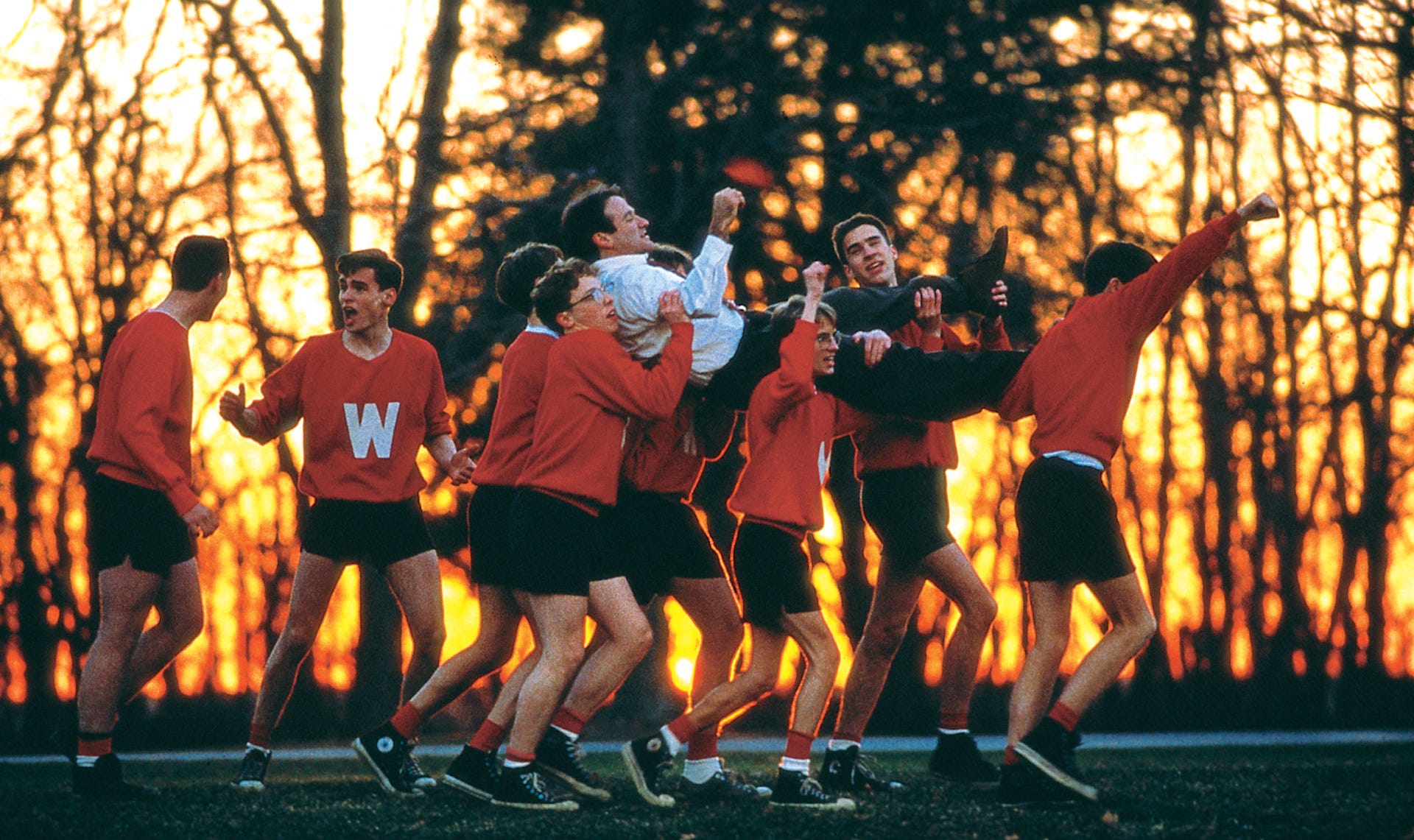
This is where Neil Perry’s story becomes particularly tragic. As the star student, he lived a life that never truly belonged to him, bearing the weight of expectations imposed by his parents. Seeking an escape from his scripted life, Neil and his friends revive the Dead Poets Society, a secret gathering where the boys retreat from Welton’s rigid world to read poetry, speak freely, and imagine lives beyond those prescribed for them.
Through the group, Neil unlocks a part of himself that had long been kept dormant: his passion for theatre. Without his father’s knowledge, he auditions for Puck in a production of Shakespeare’s A Midsummer Night’s Dream and lands the part. At last, Neil Perry finds something that makes him feel alive. For the first time, he sees a future that he wants. Turning to his roommate Todd Anderson, he admits:
“For the first time in my whole life, I know what I want to do.”
Neil gives the performance of his life. The audience applauds, and for a brief moment, the world seems to recognize the person he has discovered himself to be. But his triumph is short-lived. His father, who had explicitly forbidden him from participating in the play, arrives and discovers that Neil has gone behind his back. Furious at his defiance, he confronts Neil backstage and demands that he abandon his involvement in theatre. He insists that Neil leave Welton and attend a military academy, determined to keep him on the path toward becoming a doctor.
Then, his father arrives and furiously instructs him to withdraw from school and enroll at a military academy, insisting he focus on becoming a doctor. Neil feels defeated. “I was good. I was really good,” he whispered to his mother, desperately wishing she’d understand. She dismisses him, too.
Neil feels increasingly trapped in a world that refuses to recognize what gives him purpose. Through acting, he has finally found something that made him feel alive, only to have that possibility taken away by the very people whose approval he longs for. His father’s decision to send him to military school leaves him feeling powerless over his own future. Later that night, while the household is asleep, Neil quietly enters his father’s study and unlocks the desk drawer. Inside is his father’s revolver. He takes it, and in the devastating moments that follow, takes his own life.
The film does not present his death as a romantic consequence of pursuing art. The abrupt shift from the warmth and applause of the stage to the aftermath of his death creates a sharp contrast, interrupting the narrative and leaving the audience in shock. The film exposes the devastating consequences of a world where a young person feels his identity, desires, and future have no room to exist outside the expectations given to him by his parents.
Neil’s story reveals what is at stake when a life is confined by the expectations of others. The Dead Poets Society itself, meanwhile, offers a glimpse of what becomes possible when those constraints are briefly lifted. In the darkness of the cave, the boys read poetry, laugh, tell stories, and experiment with versions of themselves the classroom does not permit. For a few hours, they are simply young men discovering what brings them life.
Perhaps this is what art makes possible: a brief escape from the demands of the world; a space to discover what moves us and what makes life meaningful. People often claim they do not have time for art, even as they spend their whole lives searching for meaning. They pursue achievement, recognition, and wealth in the hope that these will bring them fulfillment, but meaning cannot be weighed through accomplishments alone. Sometimes, it is hidden in a poem that stays with us, a film that changes how we view the universe, a song that gives language to an emotion we can not identify, or a performance that makes us feel understood.
Carpe diem does not mean living recklessly or abandoning the future. Rather, it is the choice to live more intentionally. It is the choice to remain curious, notice the beauty others overlook, ask why things move us, and to refuse to let the commotion of life strip us of wonder.
Perhaps the more enduring lesson is that an extraordinary life simply means a life that feels, in some meaningful way, like your own. And perhaps that is what art is ultimately for: not merely to decorate our mundane lives or distract us from our struggles, but to remind us why life is worth experiencing in the first place.
To tear out the papers that taught us to follow a path laid out for us. To feel that we are alive for something more than tomorrow.
Carpe diem.