


“Beauty will save the world.”
We have heard the phrase so often that it has worn down to a stump. It sits on coffee-mug slogans, motivational posters, and book jackets, reduced to a decorative sentiment, a poetic flourish meant to comfort us when things get heavy. But what if Fyodor Dostoevsky was not offering romantic comfort? What if he was diagnosing a civilization? Perhaps the question is no longer whether beauty can save the world, but whether we still know how to see it.
The slowness of stone
You do not notice the shift immediately. You arrive in a city like Rome expecting history. You expect textbook monuments, crowded piazzas, rich espresso, and grand vistas you have already consumed a thousand times through smartphone screens. What you do not expect is what happens to your mind. It begins to slow down. Not because the city is quiet; it decidedly is not. Scooters buzz through narrow alleys like angry hornets, conversations spill out of crowded trattorias, church bells interrupt the afternoon heat, and tourists crowd every legendary square.
Yet beneath the physical noise lies a different rhythm. Somewhere between stepping across worn basalt cobblestones and sitting beneath the colossal, open-sky oculus of the Pantheon, you find yourself looking upward instead of downward. Your phone remains in your pocket a little longer. You linger over an espresso without feeling the phantom itch of unread notifications. You notice how the late afternoon light transforms ordinary travertine stone into something luminous, almost breathing. For the first time in weeks, perhaps months, you are not calculating what comes next. You are simply there. And in that stillness, a quiet, unsettling question presents itself: What if beauty is doing something to us?
The tyranny of utility
We moderns have neatly quarantined beauty, reducing it to mere preference. We speak of it as something pleasant, subjective, and ultimately optional: a weekend luxury meant for museums, vacations, or the decorative margins of life once the real work is finished. Everything else belongs to efficiency. Our cities are engineered to move us faster, our pocket devices are designed to hold our attention longer, and our digital calendars are meticulously color-coded to leave no empty spaces. Even our leisure has been colonized by productivity. Wow. We optimize our sleep cycles, quantify our physical exertion, listen to audiobooks at double speed, and congratulate ourselves on the dark art of multitasking. We have become astonishingly proficient at moving through the world, but are we still capable of beholding it?
Even before neuroscience began mapping the neural correlates of attention, Plato suggested through the voice of Diotima in the Symposium that the true lover of beauty is led upward from individual beautiful forms to universal concepts, eventually catching sight of “a beauty whose wondrous nature is finally revealed”1 , an awakening that pulls the soul away from immediate, frantic pleasures toward what is ultimately true and good. Beauty was never just about a pleasing arrangement of shapes; it was an invitation to transcend ourselves. Generations of builders understood this instinctively. Why else would humans spend centuries constructing Gothic cathedrals that no spreadsheet could ever justify? Why pour immense wealth, blood, and labor into soaring vaulted ceilings, intricate stained glass, and sacred music that echoes for miles? Because beauty teaches before words ever can. A cathedral is not merely an architectural achievement; it is theology made physical. Standing beneath the dome of St. Peter’s Basilica, one senses that the stone itself is making an argument: human beings are made for more than consumption, production, and survival. They are made for wonder and awe.
The geography of insight
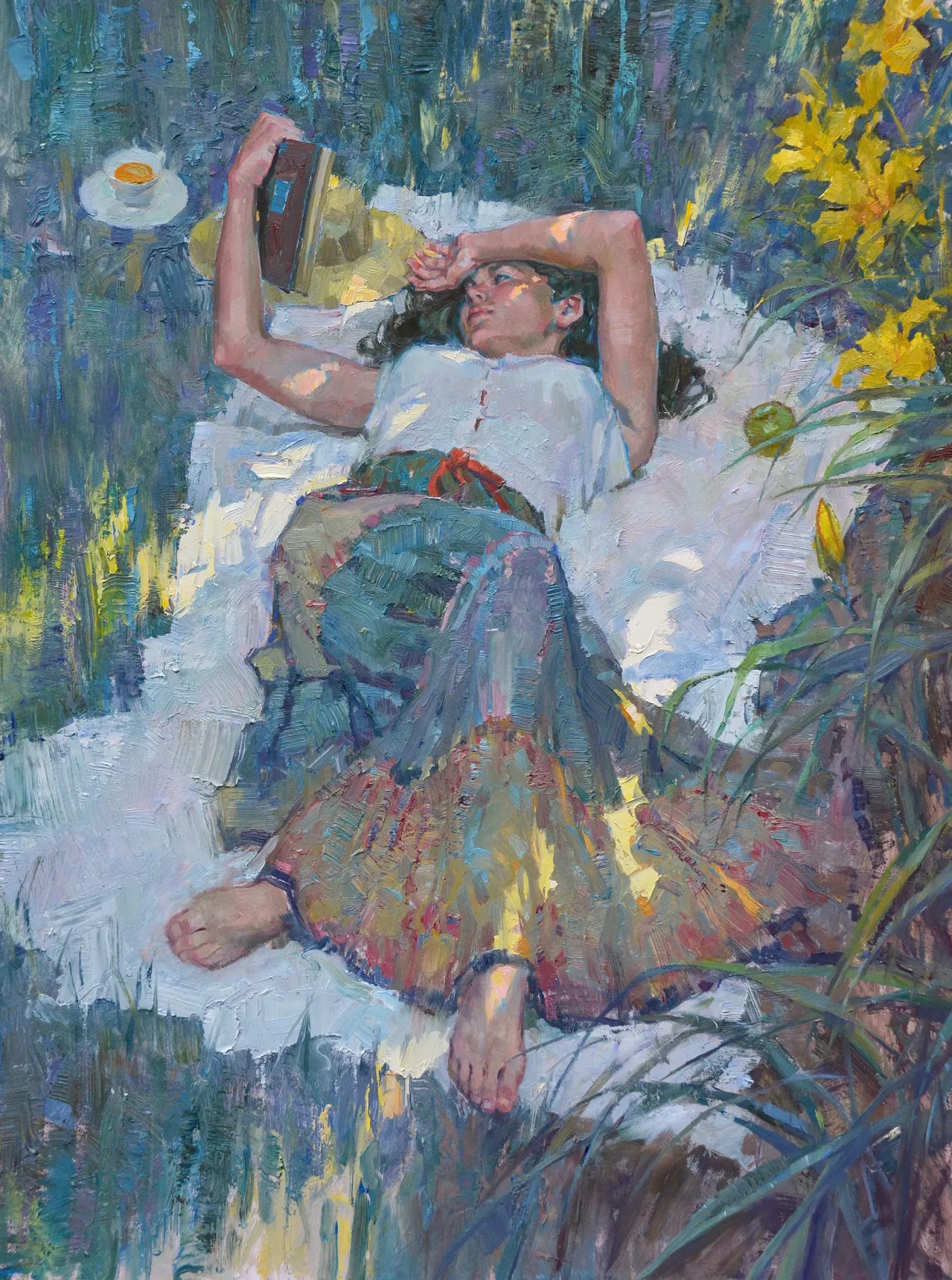
Have you ever noticed that your best, most clarifying thoughts rarely arrive while you are furiously clearing your inbox? They arrive elsewhere: while walking beside an endless sea, while listening to the unhurried mathematics of a Bach suite, while looking up at mountain ridges catching the morning sun, or while wandering down ancient streets that witnessed centuries rise and fall before your ancestors were born. This is no coincidence. Beauty interrupts us. Yes, it rescues us from the relentless tyranny of utility.
As the philosopher Josef Pieper observed, “Leisure is the basis of culture,” understood not as passive entertainment or idleness, but as “a celebratory, approving, lingering gaze of the inner eye on the reality of creation.”2 Leisure, properly understood, is the vital condition that makes wisdom possible. Without contemplation, a civilization slowly starves of its soul. Perhaps this explains our peculiar, modern exhaustion. We possess more accumulated information than any generation in human history, yet many of us have forgotten how to truly pay attention. We scroll through thousands of pixelated images every week while truly seeing almost nothing. We communicate constantly across global networks while seldom listening to the person sitting across the room. We accelerate our lives every year, wondering why everything feels increasingly shallow. Beauty quietly rebels against all of this, because a sunset cannot be rushed, a symphony cannot be skimmed, and Michelangelo’s Pietà does not yield its emotional weight in a fleeting thirty-second scroll. Some things disclose their depth only to those who are willing to remain still.
The architecture of the soul
This may be the greatest lesson left by ancient cities: not just their history or their architecture, but their pace. Rome has outlived emperors, barbarian invasions, plagues, political revolutions, and shifting ideologies. It understands a truth our age has forgotten: what truly endures is rarely what is produced the fastest. It forces us to ask a deeper question: do our cities educate us, or do they merely manage us? A city built solely for efficiency produces efficient, anxious people, whereas a city built with beauty and proportion produces contemplative people. Architecture is never neutral, and public spaces are never merely functional. Every street quietly answers a fundamental question about what kind of human being should live here.
The Swiss theologian Hans Urs von Balthasar warned of the grave cost of banishing aesthetics from public life, writing that “We no longer dare to believe in beauty and we make of it a mere appearance in order the more easily to dispose of it,” adding that whoever dismisses her will soon find that “she will not allow herself to be separated and banned from her two sisters [truth and goodness] without taking them along with herself in an act of mysterious vengeance.”3 Beauty is not a decorative bow tied around a completed civilization; it is one of the foundational conditions that keeps a civilization humane. Even contemporary psychology backs this up, as psychologist Dacher Keltner notes in his research on everyday wonder that “awe defines a distinct state of consciousness that changes how we process information, altering our sense of time and our very self-concept,”4 expanding our perspective and increasing pro-social generosity. Beauty literally changes how we inhabit our own skin.
An act of affirmation
Perhaps this is why we leave places like Rome feeling a quiet, heavy reluctance to return home. It is not simply because we enjoyed the food or the weather, but because beauty has quietly retrained our attention, reminding us of what it feels like to be fully awake. When Dostoevsky wrote through his characters that “Beauty will save the world,”5 he did not mean that a well-crafted oil painting can stop a war or that a stained-glass window can wipe out poverty. He meant something far more radical.
Beauty saves because it teaches us to love what is actually worthy of love. It reminds us that another human being is not an obstacle to navigate, but a mystery to encounter; that a city is more than a logistical grid of infrastructure; and that life itself is more than a checklist of tasks to complete before time runs out. In an age obsessed with speed, output, and algorithmic optimization, beauty performs a profound act of affirmation. It is an active choosing of depth over superficiality, a standing invitation to stop, to look, to listen, and to wonder. And perhaps contemplation is not an escape from reality after all. It is the only way we ever truly enter it.
Plato, Symposium, trans. Alexander Nehamas and Paul Woodruff (Indianapolis: Hackett Publishing, 1989), 210a–212b (specifically tracking the ascent from physical particulars to the sudden vision of absolute beauty at 210e–211d).
Josef Pieper, Leisure: The Basis of Culture, trans. Alexander Dru (San Francisco: Ignatius Press, 2009), 27–35.
Hans Urs von Balthasar, The Glory of the Lord: A Theological Aesthetics, vol. 1, Seeing the Form, trans. Erasmo Leiva-Merikakis (San Francisco: Ignatius Press, 1982), 18–19.
Dacher Keltner, Awe: The New Science of Everyday Wonder and How It Can Transform Your Life (New York: Penguin Press, 2023), 45–62.
Fyodor Dostoevsky, The Idiot, trans. Richard Pevear and Larissa Volokhonsky (New York: Vintage Classics, 2003), 317.
