


By Valerie Bringas
Fund Development Officer
At first glance, everything about Heartstrings seems to move in different directions. Co-presented by the UA&P Chorale, Phildiz Studios, and Kalinangan Youth Foundation, the event brings together groups that carry their own identity, way of working, and priorities. Their beneficiaries are just as varied—the Dizon Auditorium, the UA&P Chorale itself, and the KALFI-Balanghai Study Center. Even the forms of expression seem to belong to different worlds—photographs that freeze moments in time, songs that unfold and resonate with audiences, and formative activities, which this event seeks to support, that work quietly and patiently over the years. Add to that a mix of students, alumni, and employees, and it can easily feel like a potpourri of unrelated parts, rather than a single effort.
But somehow, it works.
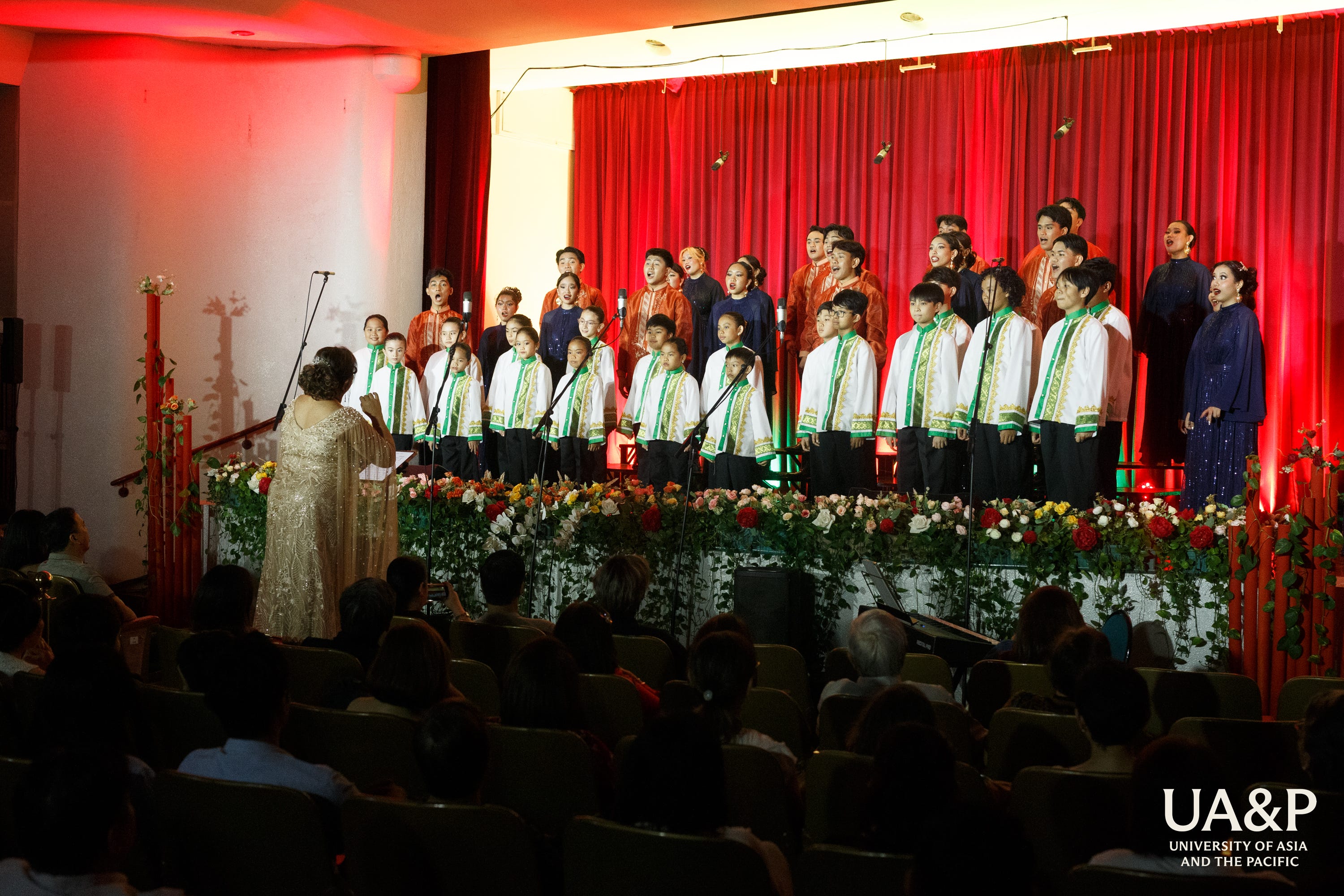
In the spirit of Unitas, these differences need not be resolved. They are simply brought into conversation with one another. Heartstrings becomes the space where this happens—not by forcing alignment, but by allowing each part to contribute what it can. The photographs invite us to pause, gaze, and ponder. The music draws people into a shared experience, something felt rather than explained. The cause of the entire event: formative activities that, though less visible, are no less real — shaping the way people think, choose, and live. Each one works in its own way, yet they all circle back to the same center: the human person.
Now, these fields are united despite their differences. During the concert, UA&P Chorale’s conductor, Anna Tabita Abeleda-Piquero, said, “Science and business may sustain our lives—but it is art and love that make those lives worth sustaining.” This is where the relationship between science and art becomes more than an abstract idea. Science and technology are often associated with precision and measurable outcomes; they help us build and organize. Art, on the other hand, deals with meaning and expression. It does not measure so much as it reveals. One might be tempted to place them on opposite sides, as if one belongs to reason and the other to feeling. In reality, they are not in competition.
In efforts like Heartstrings, their complementarity becomes clearer. The technical side—the planning and the coordination—makes the event possible. Without it, nothing would come together concretely, but it is art that gives the effort its depth and resonance. It is what allows people to connect and to be moved. Science and technology provide the structure; art fills it with life. One without the other would feel either empty or ungrounded.
What ties everything together is not uniformity, but a shared purpose. Each group remains distinct, yet each recognizes that what it offers can serve something larger than itself. There is a quiet trust in that—an understanding that unity does not mean sameness, and that difference, when rightly ordered, can become a strength rather than a source of division.
Heartstrings is not just about collaboration across groups or disciplines—it is a reminder that unity is something that can be lived, even in the midst of diversity. It shows that when people, skills, and perspectives are brought together with a common intention, they can create something that speaks more deeply to who we are. In the spirit of Unitas, what emerges is not a blurred mixture, but a harmony—one that reflects the richness, dignity, and depth of the human person.