


Somewhere along the way, the world got a little grayer. Colors have gradually faded, and the world has become more automated; just a little more efficient, and a little less felt.
ViARE’s The Anti-Color Division, written and directed by Ally Solis, an alumna of the Political Economy program, imagines that shift inside a paint company where color starts becoming an inconvenience. Staged at Dizon Auditorium from September 28 to 30, with the final show on October 3.
The story begins before anyone sits down. Each ticket handed to the audience is a time card—the kind workers use to clock in and out of a shift—and robot workers roam the audience in their seats. By the time the lights dim, the audience themselves become employees of Rainbow Paints. The future the play warns about has clocked in before us.
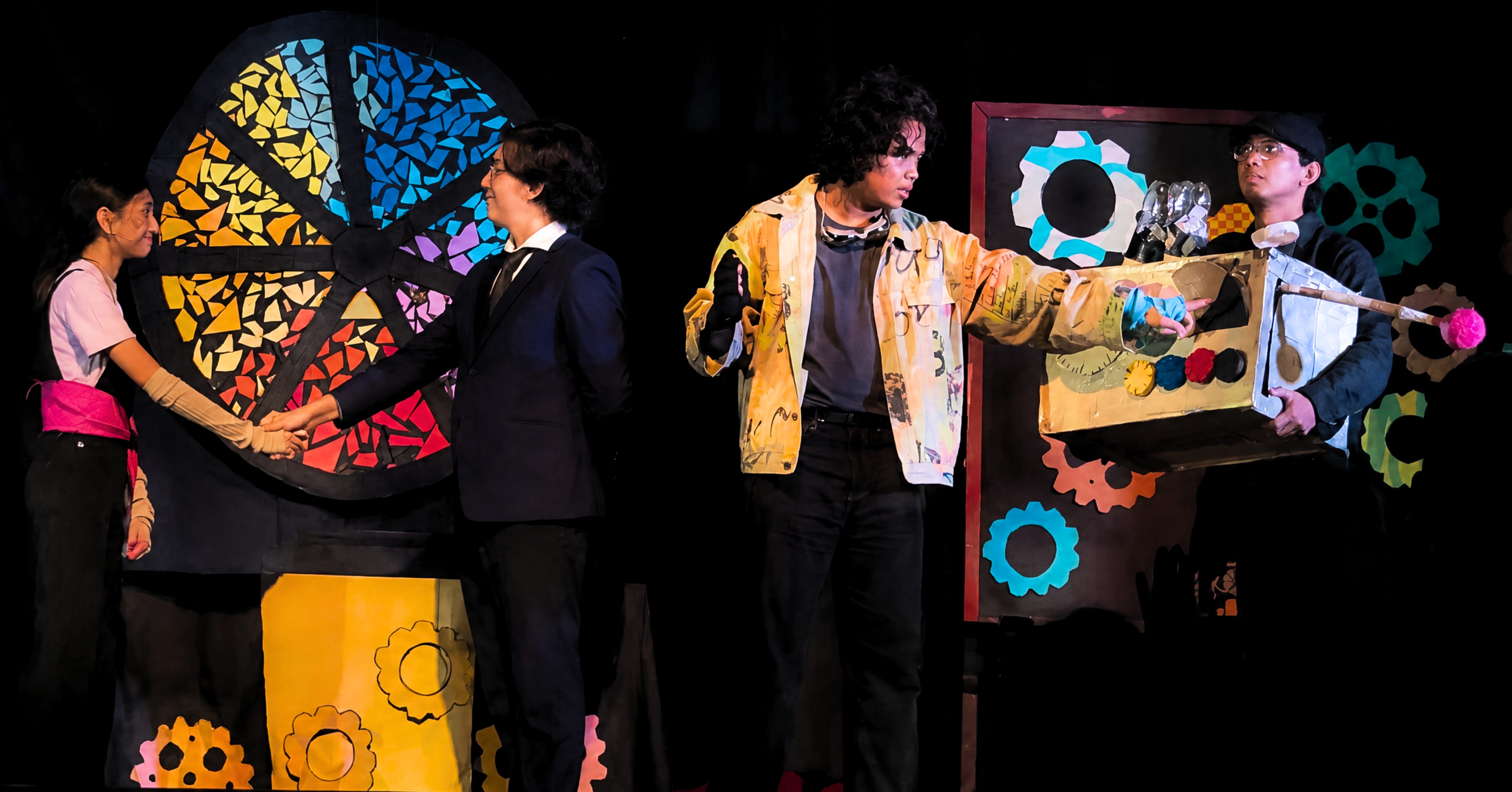
Inside, the stage becomes the workshop factory of Rainbow Paints, humming with old, nostalgic music. Workers tune the dials in the workshop and create new colors. One worker briefly breaks character to stretch her sore neck, as if doing the job really aches. The company’s slogan promises that “life could be a little less dull“, yet its neutral division gets raises and nicer workshops, while the color division gets nothing new.
Mr. Whitman, played by Rafa Racho, provides the play with an unsettling presence. He asks Reese Garcia’s Julia to create a dark white or a light black, and presents it as a simple task. In truth, it is part of his scheme: each shade moves the neutral division a step forward, while the color division is slowly phased out. Each step sounds reasonable on its own, which is how the color division disappears without anyone ever announcing it. Gray is practical. Gray is cheaper. Gray is what you get when everything is made interchangeable. It’s hard not to see our own world in that, where more tasks are automated, more experiences are streamlined, and “efficient” has quietly become another word for “good.”
Against that stands Art, played by Kay Cabacungan, who believes color is more than just pigment. To him, it carries memories, sceneries, and emotions—the things that make life feel lived. When he is told to desaturate his teal with more white, he refuses to make a gray. Julia sees the same teal differently. Where Art finds feeling, she finds deadlines and shades to make, and when she is offered a place in the neutral division, she chooses to take it. The play never casts her as wrong. Her gray is the choice most of us would make quietly; the practical one, trading wonder for something useful.
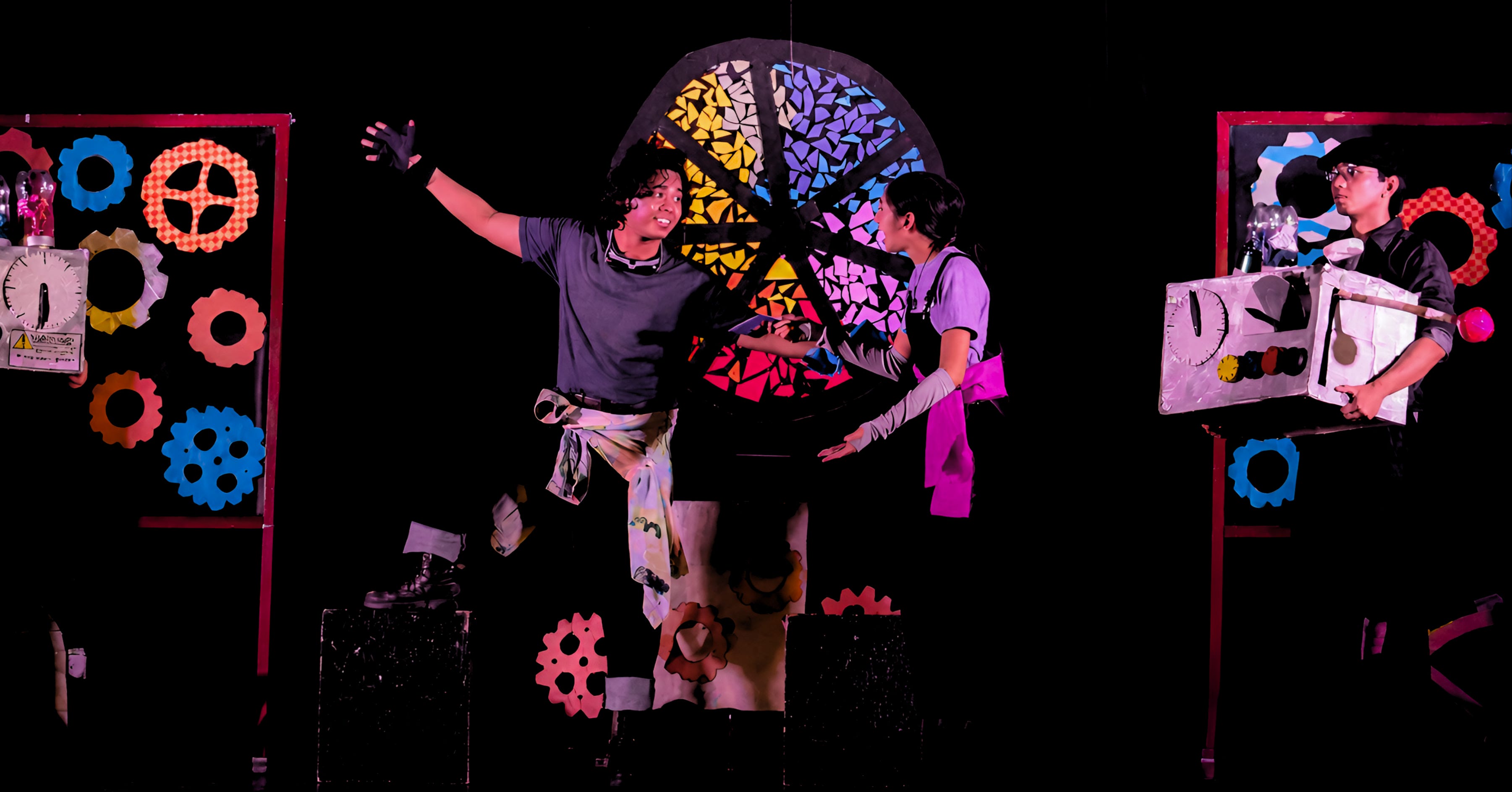
The production’s lighting does much of the arguing. Colors wash across the stage to set each mood or to paint the scene itself, so when the lights cut out mid-performance and return blindingly bright, the loss of color is felt rather than explained. The ensemble (Kyri Maramo, Tobey Perez, JD Caparas, Abram Erna, Mar Suemith) deserves its own credit. As the robots and machines of Rainbow Paints, they turned the factory itself into a performance, and later became the whirlwind that swallows Art’s fight. The robots who greeted us at the door were not only a warning about a duller future; they were part of the system that stops anyone from resisting it.
Then comes the ending. Art storms into Mr. Whitman’s office, shows off the new color he created after a week of strain, and the answer he gets leaves him with nothing to hold onto. In protest, he sprays the newly-made paint across the room and lunges at Mr. Whitman until the ensemble swarms him in a whirlwind of fighting.
Then everything stops and rewinds. None of it happened. It was all in his head, and then he quietly left.
It was the saddest moment of the night, and the most honest. Holding a belief is easy; acting on it is hard. The play suggests that dullness rarely wins by force. It wins because the people who care most are the ones who stay silent.
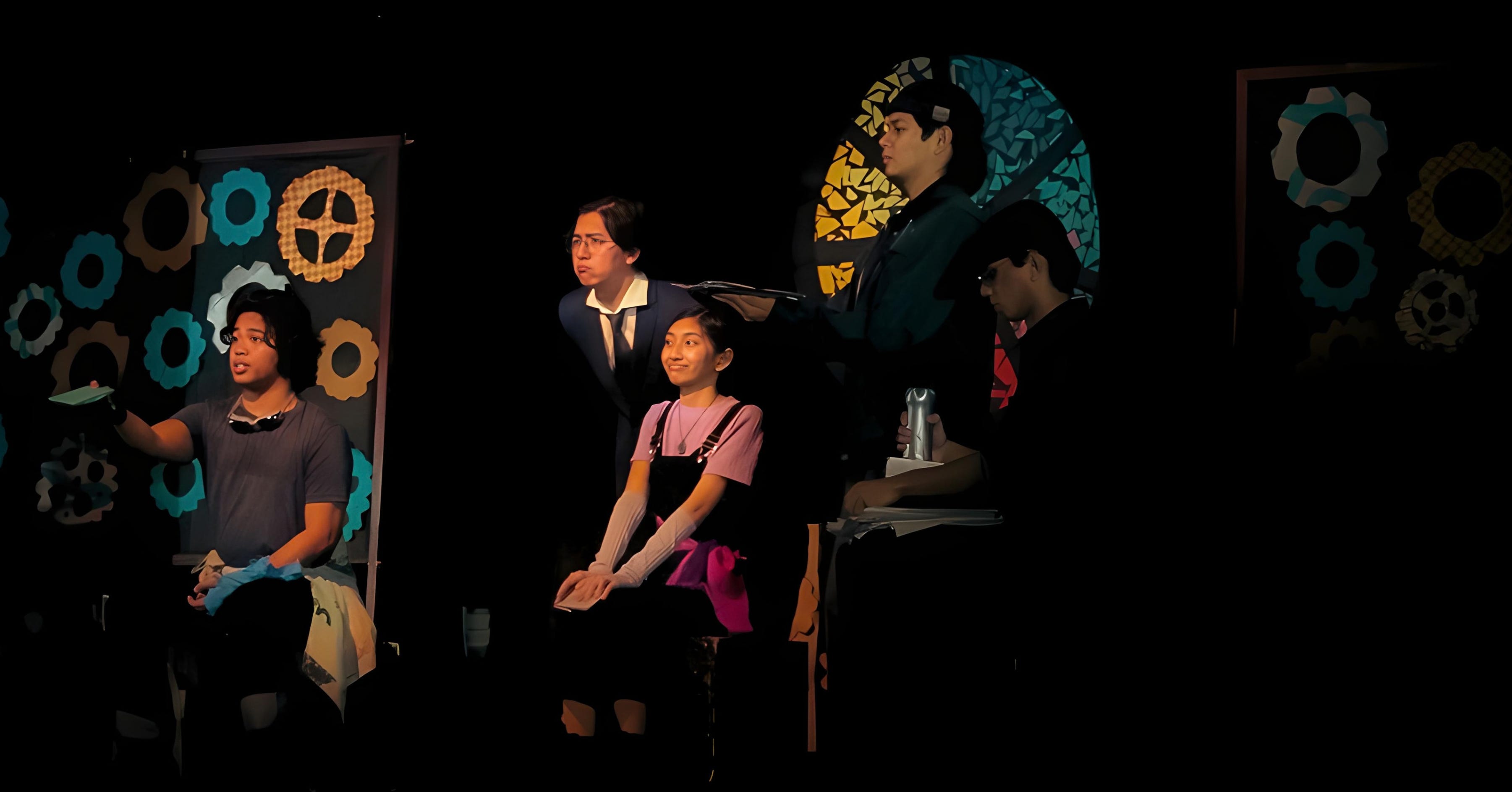
As the lights came back up and as my eyes adjusted, one thing was clear: I understood Art the most, yet part of me felt for Julia. Her decision to join the neutral division may have seemed like the wrong choice because of how important the color division is in preserving the sliver of whimsy and wonder in people’s lives. We might have mixed feelings about her decision, but we still understand it—even Art did. To believe in something takes determination, but standing by it takes more than that. And sometimes the world makes giving in look like the only practical choice.
Maybe the lesson is that the fight Art imagined, loud and all at once, isn’t the only way to stand by something. Sometimes it is smaller and quieter, like refusing to make a gray when we could make our own color, or keeping the things that make life feel lived even when no one has time for them. Art’s fight ended where it began, in his head, and that is the part worth taking home. A belief we never act on, even in the little ways, will fade just as surely as the ones we abandon.
So as the lights fade, the question lingers for everyone in the audience. What memory, what feeling, what color will you fight for before it fades?
