


By Maeliza Angel Zaguirre
3rd Year Bachelor of Science in Entrepreneurial Management Student
Deleting Canvas from my phone was the first thing I did as soon as I left my last class for the semester. I was looking forward to spending the first few days of my long-awaited break abroad.
Once finals were over, I was invited by one of my professors to write for Universitas. He said I could write about anything under the sun. As the invitation lingered, I considered what to write. None of the ideas gave me the eureka moment that compelled me to write about a specific topic until I was on an airplane with no Wi-Fi and my brother fast asleep beside me. All of a sudden, an itch arrived, which appeared as the idea for the article.
I wanted to capture it before it disappeared completely. Before I knew it, my hands were typing into my notes app, attempting to scratch the itch, leaving behind fragments of ideas I might return to later.
The itch to create is like a mosquito bite: I only notice it by the mark it leaves behind. The mark does what it does best: bother me. I have to scratch or even slap it, or else it’s bound to disrupt whatever I’m doing.
Most of the time, I don’t scratch it—I distract myself instead. Before boarding the plane, I found myself mindlessly scrolling on TikTok, as my algorithm went from an influencer showing off a massive thrift haul to a post disguising heartbreak as a means to go viral with the caption “if he wanted to, he would,” all within the span of a minute. Maybe that’s why the itch arrived. Without anything to consume, there was room to notice what wanted to be created.
We have grown accustomed to consuming media, so creating feels like a luxury—one that requires intention. As we consume endlessly, when do we actually go out of our way to scratch the itch to create?
How often do we tell ourselves “I’ll do this tomorrow” or maybe even “Someday, I’ll do it” but end up prioritizing everything else? How many times do we procrastinate to the point that the itch to create begins to fade? One of the greatest tragedies of life is not that every itch goes unscratched, but that it disappears before we ever give it a chance to become something more than a figment of our imagination.
I had scratched the itch on the airplane, but only enough to keep it from disappearing. It was only after a week that I opened a brand new Google document and started brain-dumping rhetorical questions, excerpts I had come across both online and offline, and anything I thought could become something more. Since then, I’ve been deleting pretty sentences that don’t serve this essay, jumping between Google Docs and browser tabs.
While other tasks kept demanding my attention, this particular itch kept coming back. I’ve learned that scratching it is an action, not necessarily a conclusion.
Maybe that’s what it means to scratch an itch. It doesn’t always happen in one grand decisive moment. Sometimes you scratch it a little, leave it alone, come back to it, scratch it again, and eventually realize you’ve been answering its call all along.
I have been scratching this itch for months, but scratching hasn’t meant finishing it. It means returning to it. And maybe that’s the entire point: creation doesn’t always arrive as a finished song, novel, painting, or even article. Sometimes it remains unfinished, continuing to evolve in ways the world never witnesses.
The existence of an unfinished work is tangible evidence that I answered the itch. Blaise Pascal’s Pensées,1 for instance, survives not in spite of its incompleteness but partly because of it. The Pensées is the posthumous compilation of a notebook that contained his fragmented ideas and drafts for an unfinished Christian apologetic.2 After his death, his response to that itch produced a work that, up to this day, invites readers into a mind still at work. Though unfinished, his notebook became an outlet through which his ideas endured.
If Pascal’s thoughts found their home in a notebook, then every act of creation eventually seeks an outlet. What, then, becomes an outlet for the itch?
My notes app became the outlet where invisible thoughts became visible through words. This is ultimately where drafts, lingering reflections, and inquiries born of hunger are preserved, often riddled with typographical errors. They emerge between rush-hour commutes, location transfers, minor inconveniences, major milestones, sometimes with nothing more than 2% battery left on my phone. The outlet gave those thoughts a place to exist in their most unfiltered form, one that cannot be perfectly reconstructed later.
Why, then, do I always somehow need an outlet for the itch? The itch itself haunts me everywhere I go and dares to interrupt me as I go about my day. Perhaps this itch is not mine alone to experience, but one that is shared. Why do we have this impulse to make the invisible visible?
One philosophical perspective begins with what is called the inner world. Each of us has a unique world shaped by our experiences, desires, and surroundings.3 Philosopher Antonio Malo describes affectivity through the Latin verb afficior, meaning “I am moved, affected”.4 In this sense, affectivity describes what happens when something outside our inner world encounters us, thereby moving us. The encounter isn’t isolated. We are in a relationship with what affects us.5 The itch is what happens when reality has already affected us. It is the felt impulse that emerges when something has affected us, and we are moved to respond.
At the psychological level, being affected is not simply a matter of feeling; we become conscious of what moved us, interpret it, give it a name, and eventually decide what we want to do with it.6 Affectivity explains why reality can move us while psychology describes what happens as we become conscious of and interpret the movement. But neither, by themselves, answer the question:
Where does the itch even come from?
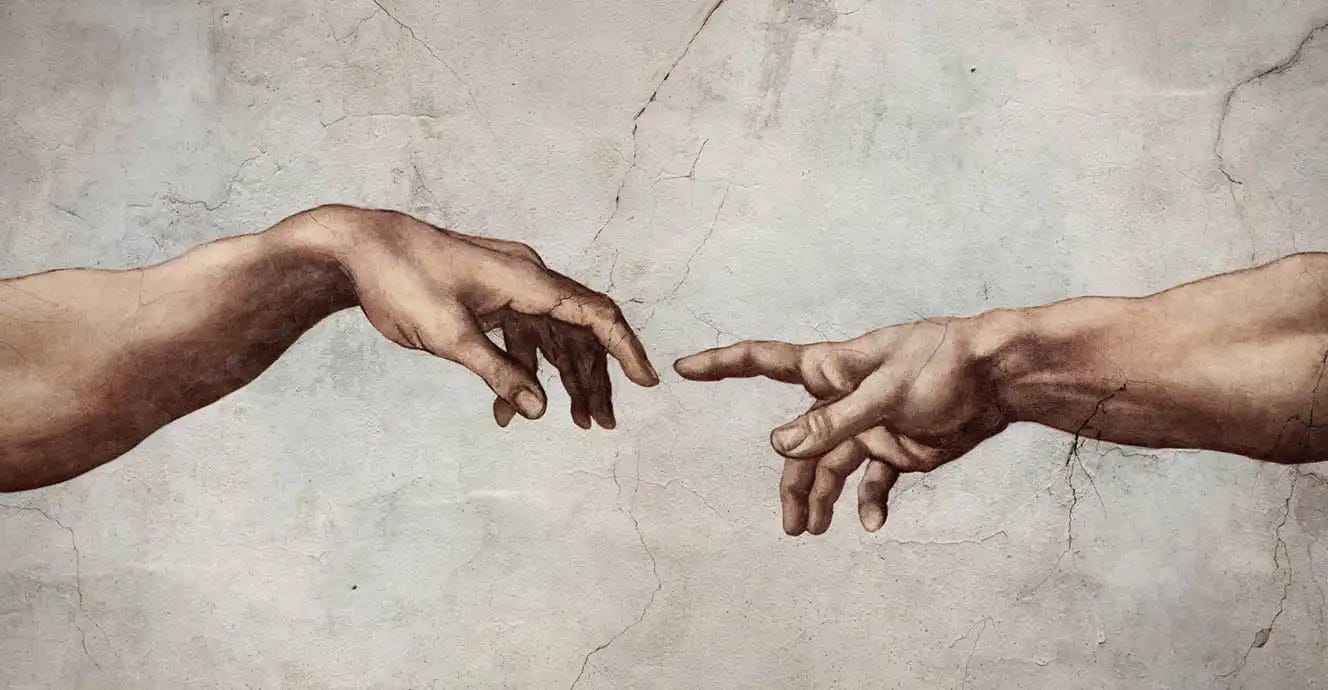
In the beginning, God created the heavens and the earth.7 He who wove an abstraction of nothing into concrete existence. God created a world worth responding to. Therefore, we create in response to Him. The itch to paint the sunset when it kisses the horizon before it disappears into the night. The itch to photograph a scenic route you always visit at golden hour. The itch to write a letter to express a love that couldn’t be fully captured in language, yet you do it anyway.
Maybe the itch doesn’t just appear for us to say that we made something, but because something within us overflowed into reality—through creation.
As my flight touched down instead of allowing my algorithm to decide what occupies my attention, I reached for my notes app: “resolve the article revisions” beside an unmarked checkbox. What you are reading is the form the itch took when I finally scratched it.
As summer vacation fades into my memory, I’ll have to install Canvas yet again. Some things may remain the same when the school year begins: the crowded hallways between classes, familiar faces across campus, and the ALB pond catching the afternoon sun.
But now I know that the itch isn’t there to distract me; it invites me to respond.
For when it comes, I must scratch it. One itch at a time.
Blaise Pascal, Pensées, trans. A. J. Krailsheimer (Penguin Classics, 1995). Pensées is French for “Thoughts” and is an unfinished collection of Pascal’s notes.
Desmond Clarke and William Wood, “Blaise Pascal,” Stanford Encyclopedia of Philosophy, August 21, 2007, https://plato.stanford.edu/entries/pascal/.
Christina G. Morales, Philosophical Anthropology: Understanding the Self: Module 5, “Affectivity” (course lecture notes, University of Asia and the Pacific, 2026), citing M. A. Cenzon, Introduction to Philosophical Anthropology (Provisional Draft Version, 2008).
Antonio Malo, “The Role of Affectivity in Human Flourishing: The Internal Relation between Affectivity, Ethos, and Bonds,” Current Research in Psychology and Behavioral Science 5, no. 2 (2024): 1.
Malo, “The Role of Affectivity in Human Flourishing,” 2–3.
Malo, “The Role of Affectivity in Human Flourishing,” 7.
New International Version, Genesis 1:1.